The European Physical Society released a new Cebr report about “The Importance of Physics for the Economies of Europe”
Brussels, 4th November 2025
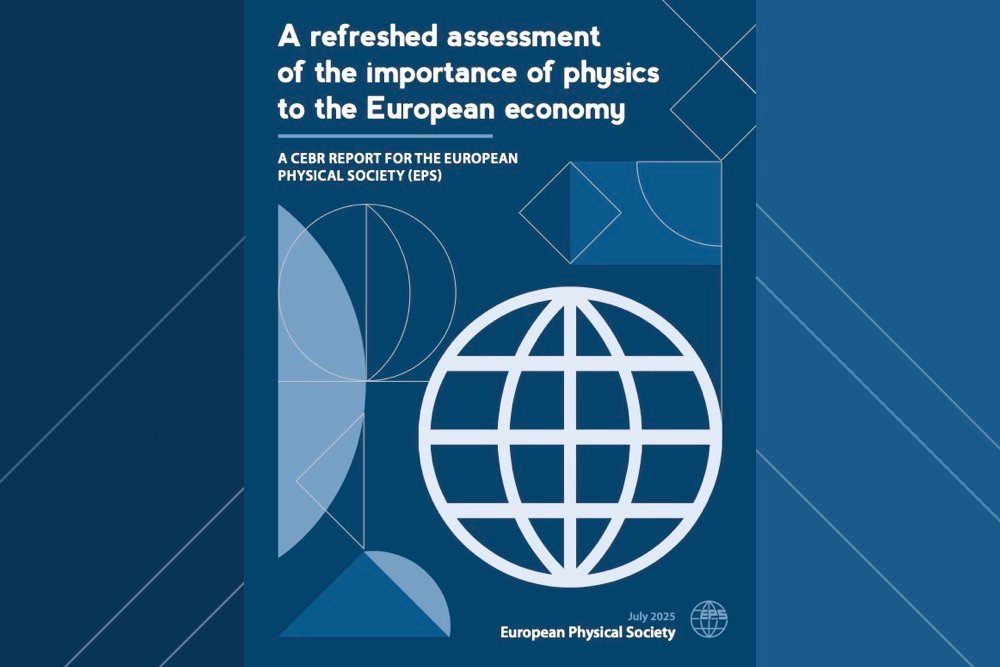
The European Physical Society (EPS) and the Centre for Economic and Business Research (Cebr) have released the third edition of the report “The Importance of Physics to the Economies of Europe”. An update to the previous version released in 2019, this report covers the years 2016-2022 and details the impact of physics-based businesses on the economy of the EU member states, three EFTA countries and the UK.
The report demonstrates that physics is not only a scientific field—it is a strategic driver of growth, productivity, and resilience. The report shows that physics-based industries had €7.07 trillion in turnover in 2022 and contributed €2.30 trillion in Gross Value Added (GVA) in 2022. Physics based industries are resilient with a strong post-pandemic recovery in business creation, employment and output. Whilst Germany as the EU’s largest economy dominates in absolute terms, physics-based industries make up significant proportions of the economies of other European countries, for example more than one in six Swiss workers and over 15% of workers in the Czech Republic, Slovenia and Slovakia were employed around physics-related activities in 2022.
Physics based industries directly support 20.1 million jobs, and productivity of workers in these industries is 68% higher than the European average.
The report highlights that the physics-based sector has increased its investment in research and development (R&D) activities by 36.5% since 2016 excluding internal investments in R&D activities which cannot be quantified.
Prof. Mairi Sakellariadou, the EPS President says “the report demonstrates that investment in physics research and education translates into quantifiable benefits to the European economy. The highly skilled workforce in this sector is extremely productive, and we should support future generations to work in these industries”
Owen Good, Director and Head of Economic Advisory at Cebr said “Our findings demonstrate the continued economic value that the physics community bring to the European economy. Since we last conducted similar analysis in 2018, we have found a significantly increased economic contribution, with the physics-based sector employing over 20 million people and directly contributing over €2.3 trillion to the European economy in 2022. Underpinning this contribution is a strong post-COVID recovery, with the sector rebounding well to pre-pandemic levels of economic activity.”
About the EPS
The European Physical Society (EPS) is a not-for-profit association whose members include 42 National Physical Societies in Europe, individuals from all fields of physics, and European research institutions and physics-based companies.
As a learned society, the EPS engages in activities that strengthen ties between physicists in Europe. As a federation of National Physical Societies, the EPS advocates for issues of common interest to all European countries relating to physics research, science policy and education. Go to www.eps.org
EPS Contact: anne.pawsey@eps.org
About Cebr
Cebr is an independent London-based economics consultancy providing economic impact assessment, forecasting and policy analysis for public and private sector clients www.cebr.com