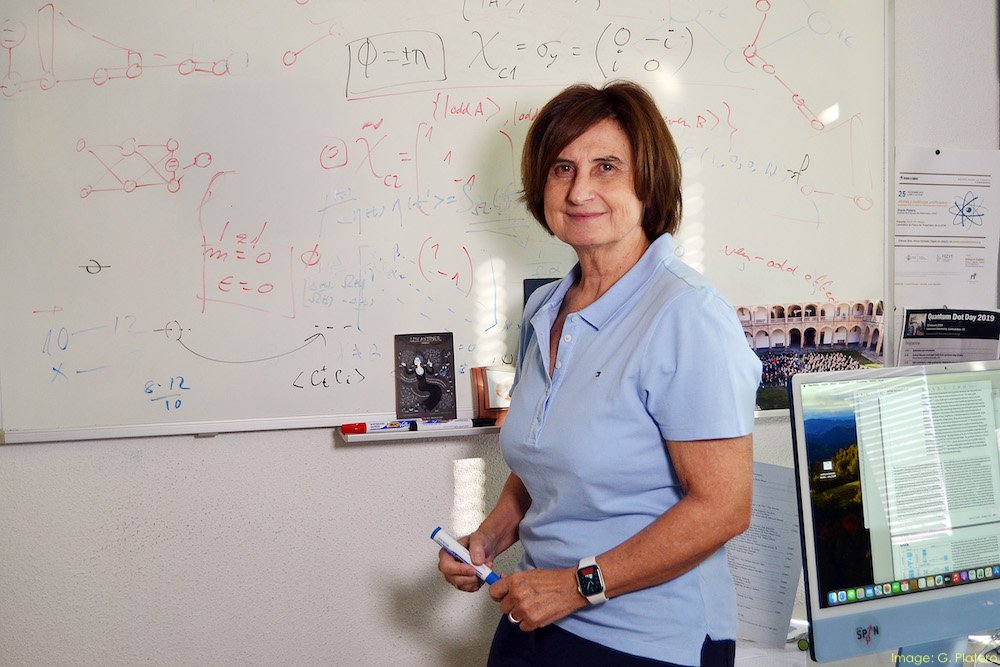
Gloria Platero, research professor at the Materials Science Institute of Madrid of the Spanish National Research Council (CSIC), was awarded the 2023 EPS Emmy Noether Distinction “in recognition of her remarkable contributions to the theoretical understanding of out-of-equilibrium (Floquet) systems and their impactful application to quantum materials, for her excellent mentorship of young researchers, and for tirelessly fostering female talent in physics.”
Petra Rudolf, chair of the EPS Equal Opportunities Committee, interviewed Prof. Platero.
How did you decide for a career in physics?
I grew up in a home where science was part of everyday life. My mother was a mathematician, and my father, an engineer with a deep love for physics. So my curiosity and appreciation for science were encouraged from a very young age. At high school, I had an exceptional chemistry teacher who truly nurtured my curiosity and always encouraged me to ask questions and dig deeper. That experience made me want to understand more about atoms and ultimately led me to choose physics.
Interestingly, my physics teacher at the time didn’t think that girls should study physics – but I was determined to follow my own path. When I began my studies at university, Spain was still under the Franco regime—a period marked by conservative attitudes and traditional gender roles. Female role models in physics were virtually nonexistent. During my doctoral research at the Autonomous University of Madrid, we were only two women among all the physics PhD students. It was a lonely place to be at times, but it also made me resilient.
How is it for current female physics students and starting academics?
There has certainly been progress. We now see more women entering physics in Spain, and the overall atmosphere is more welcoming. However, as you move up the academic ladder, the number of women goes down. The so-called “scissor diagram” still applies, and the upper levels of academia remain male-dominated. Unfortunately, this is not unique to Spain. Even in Northern European countries, which lead in gender equality according to the 2024 World Economic Forum report, the proportion of women professors in physics is still far below where it should be. In countries like Japan, the numbers remain dramatically low.
It’s not only a question of representation—visibility also matters. Women in physics are often less visible in leadership roles and high-profile events. Additionally, we’re often burdened with a heavier share of committee work, which can detract from research time. That said, I want to be clear: I do not want to complain. I consider myself incredibly fortunate to have had such a fulfilling career. Working as a physicist is deeply gratifying.
To my younger female colleagues, I would say: Don’t stay in the shadow of a famous supervisor, even if it feels safe or convenient. Step forward and show the world what you can do. It’s essential to carve out your own space and voice in science. Start by asking questions at conferences!
I would also like to emphasize how important it is to share your life with someone who supports your career. In my case, my husband — though not a scientist but an engineer — has always been a strong and unwavering source of support.
What do you recommend the physics community does to foster diversity?
We all need to take a more active role in mentoring and supporting the next generation. Sharing our experiences—both successes and setbacks—is crucial. As a community, we should pay close attention to the representation of women and other underrepresented groups at conferences and workshops. We must advocate for talented colleagues to be included in speaker line-ups and panel discussions.
Organisers should also make conferences more inclusive by offering childcare facilities and structured networking opportunities for women in physics. These seemingly small actions can make a big difference in building confidence and fostering a sense of belonging.
As PhD supervisors, we should speak honestly with our students—not just about the excitement of doing physics, but also about the realities of academic life. It’s important to highlight that the so-called “alpha personalities” in our field are not always the happiest and most fulfilled, no matter how much recognition they receive. We must encourage our students to build a career path that gives them energy and joy—to find their own resonance state, so to speak. If they’re unhappy or feel stifled, it’s perfectly valid to change supervisors or move to another institution.
We should give our PhD candidates opportunities to attend schools and conferences to build their networks. In the last phase of the doctoral work they should take on responsibilities like helping with the supervision of younger students. They should feel like what they are: essential members of the team.
And one more very important thing: in our working life, we should be kind to each other, celebrate our colleagues’ successes, and foster an environment where support and appreciation are the norm.