Author: Luisa Cifarelli
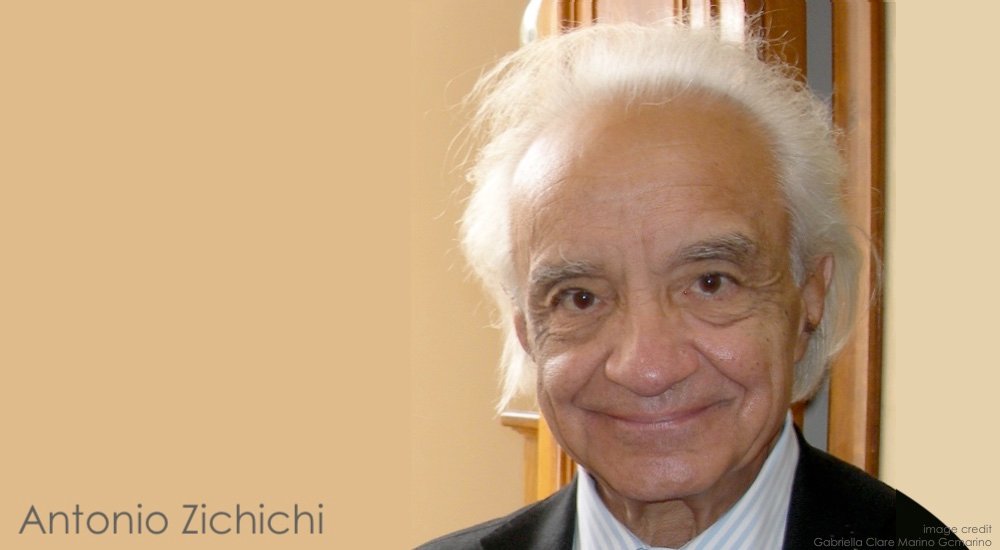
Antonino Zichichi, an influential and leading figure in high energy particle physics, passed away on 9 February 2026 at the age of 96. Professor Emeritus at the University of Bologna, Benedictine Member of the Academy of Sciences of the Institute of Bologna, and founder of the “Ettore Majorana” Centre for Scientific Culture in Erice, he held numerous prominent roles in the international scientific community. These included President of the Italian National Institute for Nuclear Physics (INFN), the “Enrico Fermi” Historical Museum of Physics and Study and Research Centre, the European Physical Society, the World Federation of Scientists, and the World Laboratory.
The conception and creation of the INFN Gran Sasso National Laboratories are credited to him. His contributions and decisive drive were also fundamental to the realization of major particle accelerators, such as LEP at CERN and HERA at DESY. His visionary project for a proton supercollider, named ELOISATRON and proposed in the late 1970s, had anticipated the LHC at CERN as its first phase and foreshadowed the Future Circular Collider (FCC) project, an integral part of CERN’s strategic plan for the coming decades.
A true promoter of cutting-edge experimental research at the laboratories of Frascati, CERN, DESY, and Gran Sasso, he and his team achieved fundamental results in nuclear and subnuclear physics. These include the discovery of the antideuteron —the first example of nuclear antimatter— the discovery of new phenomena in QCD (such as the leading effect and effective energy), and the discovery of the first beauty baryon. He also established significant limits on free quark production in strong and weak interations, and on heavy lepton (t) production in e+e– collisions, the existence of which he first proposed, developing and testing a new method to search for it, which then led to its actual discovery.
Furthermore, he pioneered original particle detection techniques, such as the preshower in calorimetry, and achieved intense R&D for new detectors within the framework of the CERN LAA project. Notably, he led the development of novel microeletronic chips and of the Multigap Resistive Plate Chambers (MRPCs) for measuring particle time-of-flight (TOF) with record precision; these devices still constitute the large TOF apparatus for particle identification of the ALICE experiment.
His commitment to disseminating scientific culture was remarkable, innovative, and of immense scope, spanning articles, interviews, television appearances, seminars throughout Italy and beyond, and numerous books for a general audience on major themes and figures of physics.
As for dissemination, it is worth mentioning the unique and still ongoing EEE project he has launched and successfully expanded over the years. This is a true astroparticle physics experiment carried out through a network of muon telescopes (each made up of three layers of MRPCs) installed in more than 50 high schools throughout Italy and all connected to the INFN CNAF computer centre. Together, these telescopes form an unprecedented observatory that combines teaching and research in physics, involving hundreds of students every year.
His leadership in international collaboration for the study of planetary emergencies, advocating for a science without secrets or borders, leaves an indelible mark on the scientific community. The Erice Statement, which he co-authored in 1982 with Nobel laureates Paul A. M. Dirac and Piotr Kapitza, remains a milestone in the quest for a peaceful future in the face of ongoing nuclear proliferation threats.
With the passing of Antonino Zichichi, we lose an eminent figure in contemporary science and a key player in physics at the turn of two centuries. We also lose an outstanding mentor who always offered great opportunities to all those who had the privilege of working with him and whose legacy will live on for future generations.