

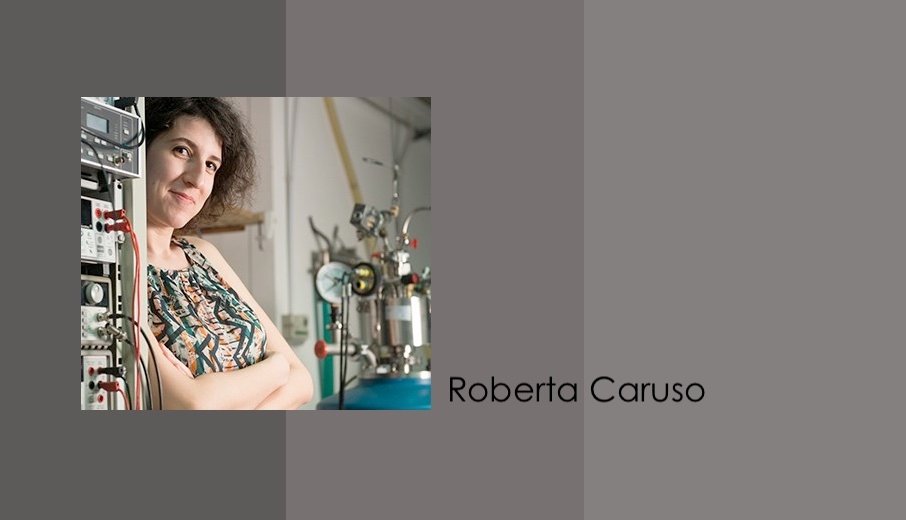
Author: Roberta Caruso I have been involved with EPS Young Minds since its beginning in 2010. As I grew up, I became more and more involved, until former YM Chair Dr Antigone Marino – recognizing my drive as a young scientist – asked me to join the Action Committee. Later, I was elected Chair from 2018 to 2020, within the European Physical Society. During those years, I focused on building a solid and close-knit network of early career researchers throughout Europe, fostering personal and scientific relationships. My term ended just as the pandemic began, but I was able to witness first-hand the network’s tenacity in adapting to new challenges and continuing to support its members. Being a member of the Action Committee of EPS Young Minds was a turning point I didn’t see coming. Being part of Young Minds gave me much more than organizational experience. It gave me motivation and drive at times when my academic career felt uncertain and not particularly successful. On several occasions, I found myself questioning my professional value, and it was this project that helped me stay grounded. Through my involvement, I also learned more about myself as a scientist. While I genuinely enjoy tinkering in the lab, I gradually realized that I am not the person who “builds” science from scratch. I am not the one with sudden, brilliant intuitions about physical processes or microscopic mechanisms, nor someone who can effortlessly design experiments to test new ideas. Instead, I am someone who loves information: collecting large amounts of it, connecting it, and using it in sometimes unexpected contexts. In other words, I am a very good learner—perhaps even an excellent one—but not a natural inventor. Young Minds was the ideal environment for developing and valuing this way of thinking. It allowed me to engage with science broadly, exchange ideas across disciplines, and reflect on the wider implications of research. At the same time, it helped me build a strong international network of colleagues, mentors, and friends that continues to shape my career. The best part is that this network now extends far beyond the specific research field I specialized in, giving me perspectives and opportunities I would never have encountered otherwise. Looking back now, I find that colleagues frequently remember me for my leadership in YM just as much—if not more—than for my scientific papers. At the time, I wasn’t sure if that was a good thing, but I see now that YM gave me a “label.” It distinguished me from the mass of other researchers. It proved I wasn’t just another physicist in a lab coat; I was someone who could lead, organize, and build. Academia is tough, highly competitive, and there is no “easy mode” for success. But if you are willing to put in the work, Young Minds can genuinely help kickstart your career, beyond all those numbers that nowadays define career progression for academic researchers. One final thought: don’t settle. If your current research environment doesn’t appreciate or support the service work you do for the scientific community through EPS, that is their loss. If they don’t see how this makes you a better, more connected scientist, maybe it is time to consider moving somewhere that does. You might not realize it now, but you really are building a global profile for yourself, even though maybe this isn’t the conventional way to do it. Don’t let a local mindset hold you back: if you think there’s value in building communities and networks, EPS Young Minds might be the right place for you.
EPJ TI relaunch
After a period of intense preparation, the official relaunch of European Physics Journal Techniques and Instrumentation (EPJ TI) is ready. The journal returns with a refreshed vision and a brand new homepage, available at: https://link.springer.com/journal/40485. A key highlight of this relaunch is the newly restructured Editorial Board, developed in close collaboration with EPS Young Minds. The board now welcomes a group of Early Career Researcher (ECR) Associate Editors, selected through a highly competitive recent call. Candidates included advanced PhD students and postdoctoral researchers within six years of completing their PhD and not holding a permanent position. These ECR Associate Editors will bring fresh perspectives and join the Board alongside the newly appointed Editors-in-Chief, forming a dynamic and forward-looking editorial team. As EPJ TI continues to grow, the board will further expand, reflecting the journal’s evolving scope and ambitions. With its renewed energy and international outlook, EPJ TI is ready to serve as a vibrant platform for cutting-edge research in Techniques and Instrumentation.

Anna Grigoryan joins the EPJ Steering Committee
Author: Tsovinar Karapetyan The Steering Committee of EPJ is pleased to welcome Anna Grigoryan as the new representative of EPS Young Minds in the Scientific Advisory Committee. She is replacing Carlos Damián Rodríguez Fernández, continuing the collaboration established two years ago. Anna Grigoryan is a PhD student and researcher in experimental nuclear physics at the A.I. Alikhanyan National Science Laboratory in Yerevan, Armenia. Working within the Experimental Physics Department, her research focuses on nucleon structure and spin phenomena in semi-inclusive deep inelastic scattering. Her work specifically explores dihadron production and beam-helicity asymmetries using data from the HERMES experiment at DESY. Through this research, she contributes to advancing the understanding of the three-dimensional structure of the nucleon. Anna is also actively involved in international scientific collaborations. She is a member of the Structure and Spectroscopy of Hadrons Project (SHARP) COST Action and contributes to the EPS Technology and Innovation Group (EPS TIG). Beyond her research, Anna is deeply engaged in outreach and community leadership. As a member of the EPS Young Minds Action Committee, she has played a key role in organising international masterclasses and physics events at her institution, helping to promote education and public engagement in particle and nuclear physics. Anna Grigoryan’s appointment highlights the important role of early-career researchers in shaping scientific communities. Readers are encouraged to follow EPS Young Minds initiatives and participate in upcoming events to support the next generation of physicists.
Women in Nonequilibrium Statistical Physics: Call for submission
The meeting will bring together researchers working on nonequilibrium statistical physics across theory, numerics, and experiments to discuss recent advances and current challenges in the field (active and living matter, glasses and driven systems, stochastic thermodynamics, foundations of nonequilibrium theory, quantum dynamics). The conference is open to participants of all genders, early-career researchers are particularly encouraged to apply. Deadline for submission: 7th June 2026. You will find more info at: https://indico.fys.kuleuven.be/event/162/
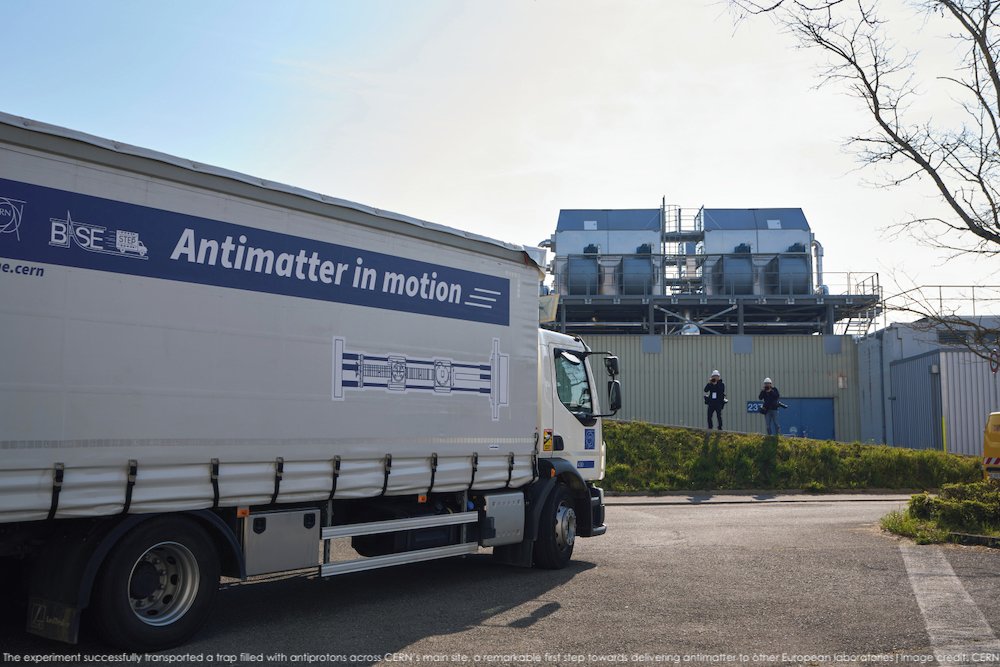
BASE experiment at CERN succeeds in transporting antimatter
On 24th March, in a world first, a team of scientists from the BASE experiment at CERN successfully transported a trap filled with antiprotons in a truck across the Laboratory’s main site. The team managed to accumulate a cloud of 92 antiprotons in an innovative portable cryogenic Penning trap, then disconnect it from the experimental facility, load it onto a truck and continue experiment operation after transport. This is a remarkable achievement, given that antimatter is very difficult to preserve, as it annihilates upon contact with matter. This world premiere is a test, the ultimate aim being to transport antiprotons to other European laboratories, such as Heinrich Heine University Düsseldorf (HHU), where very-high-precision measurements of the antiproton properties could be performed. Antimatter is a naturally occurring class of particles that is almost identical to ordinary matter except that the electric charge and magnetic moment are reversed. According to the laws of physics, the Big Bang should have produced equal amounts of matter and antimatter. These equal-but-opposite particles would have quickly annihilated each other, leaving an empty Universe. However, our Universe contains predominantly matter, and this imbalance has baffled scientists for decades. Physicists suspect that there are hidden differences that may explain why matter survived and antimatter all but disappeared. To deepen our understanding of antimatter, the BASE collaboration aims to precisely measure the properties of antiprotons, such as their intrinsic magnetic moment, and then compare these measurements with those taken with protons. But they now face a problem: “The machines and equipment in CERN’s ‘antimatter factory’, where BASE is located, generate magnetic field fluctuations that limit how far we can push our precision measurements,” explains Stefan Ulmer, Spokesperson of BASE. These fluctuations are minuscule, of the order of one billionth of a tesla, 20 000 times smaller than the magnetic field of the earth, and undetectable outside the building. “However, the precision of the measurements taken in BASE is such that gaining an even deeper understanding of the fundamental properties of antiprotons will require moving the experiment out of the building,” says Stefan Ulmer. CERN’s “antimatter factory” is the only place in the world where antiprotons can be produced, stored and studied. Two successive decelerators, the Antiproton Decelerator (AD) and the Extra Low Energy Antiproton ring (ELENA), provide several experiments with low-energy antiprotons – the lower their energy, the easier they can be stored and studied. Among these experiments, BASE holds long-standing records for containing antiprotons for more than one year, and the experiment has invented this pioneering approach in order to move on to the next stage: transporting antiprotons to an offline space for more precise experiments as well as sharing them with others. That’s why they developed the BASE-STEP trap: an apparatus designed to store and transport antiprotons. “Our aim with BASE-STEP is to be able to trap antiprotons and deliver them to our precision laboratories at a dedicated space at CERN, HHU, Leibnitz University Hannover and perhaps other laboratories that are capable of performing very-high-precision antiproton measurements, which unfortunately is not possible in the antimatter factory,” explains Christian Smorra, the Leader of BASE-STEP. “We validated the feasibility of the project with protons last year, but what we achieved today with antiprotons is a huge leap forward towards our objective.” BASE-STEP is small enough to be loaded onto a truck and fit through ordinary laboratory doors, and it can withstand the bumps and vibrations of transport. The current apparatus – which includes a superconducting magnet, liquid helium cryogenic cooling, power reserves and a vacuum chamber that traps the antiparticles using magnetic and electric fields – weighs 1000 kilograms: much more compact than BASE or any other existing system used to study antimatter. “To reach our first destination – our dedicated precision laboratory at HHU in Germany – would take us at least 8 hours,” says Christian Smorra. “This means we’d have to keep the trap’s superconducting magnet at a temperature below 8.2 K for that long. So, in addition to the liquid helium , we’d need to have a generator to power a cryocooler on the truck. We are currently investigating this possibility.” Nevertheless, the greatest challenge remains on arrival at the destination: to transfer the antiprotons to the experiment without them vanishing. “Transporting antimatter is a pioneering and ambitious project, and I congratulate the BASE collaboration on this impressive milestone. We are at the beginning of an exciting scientific journey that will allow us to further deepen our understanding of antimatter,” says CERN Director for Research and Computing, Gautier Hamel de Monchenault.
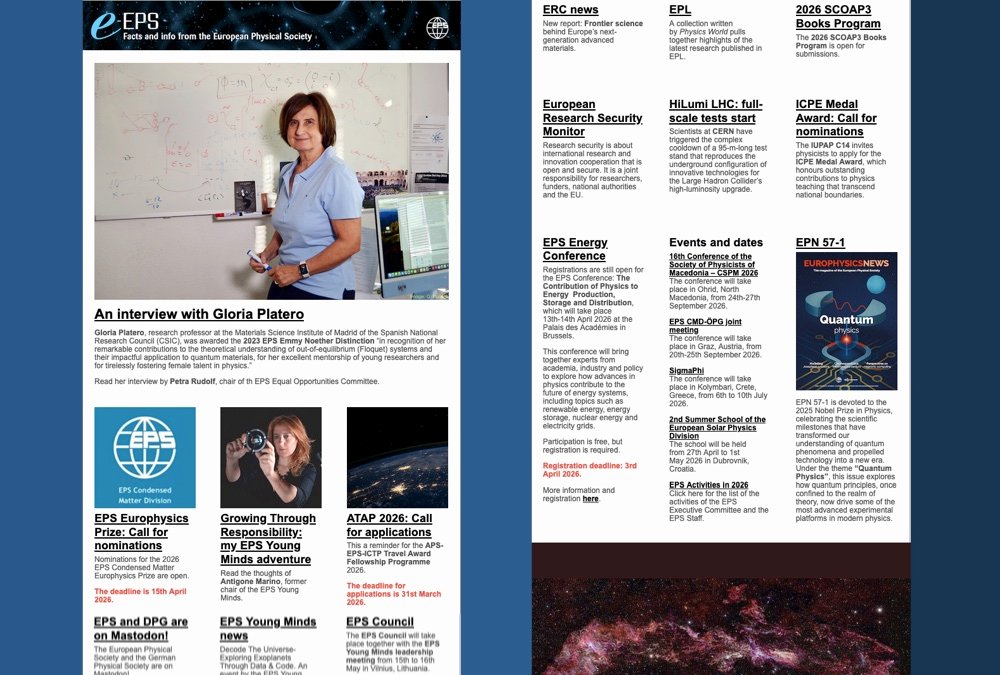
The March 2026 issue of e-EPS is out!
Read the latest issue of our online newsletter here!
The European Physical Society and the German Physical Society are on Mastodon!
Authors: Mario Birkholz and Gina Gunaratnam Mastodon is a decentralised, open-source social network that operates through independent servers (instances) interconnected with one another, allowing users to control their experience, privacy, and community rules. Here are its core features: – Open to everyone: You don’t have to be registered to see the posts published on Mastodon – Federated network: Users join a specific instance but can follow and be followed by accounts on any other Mastodon server, giving them a global reach while keeping control in their own hands – No central control: Each instance sets its own rules and moderation policies, enforced locally rather than by a single corporate entity – Privacy-first: Posts can be set to public, unlisted, private, or direct, and content warnings can hide the main body until clicked – Rich media support: Text, images, audio, video, polls, animated avatars, custom emojis, and more are all possible within a single post – User-friendly timeline: Posts appear in chronological order without algorithms or ads, letting users curate what they see The European Physical Society created its own account in 2020. Since then, this network has slowly been adopted by universities and scientific institutes. In 2025, the German Physical Society was approached by its members to establish European digital sovereignty in the area of social media. You can create your own account to: If you don’t wish to have an account, you can still follow our publications as the network is open. The EPS would like to encourage members of its community to join this social media. More info about Mastodon: Sources:
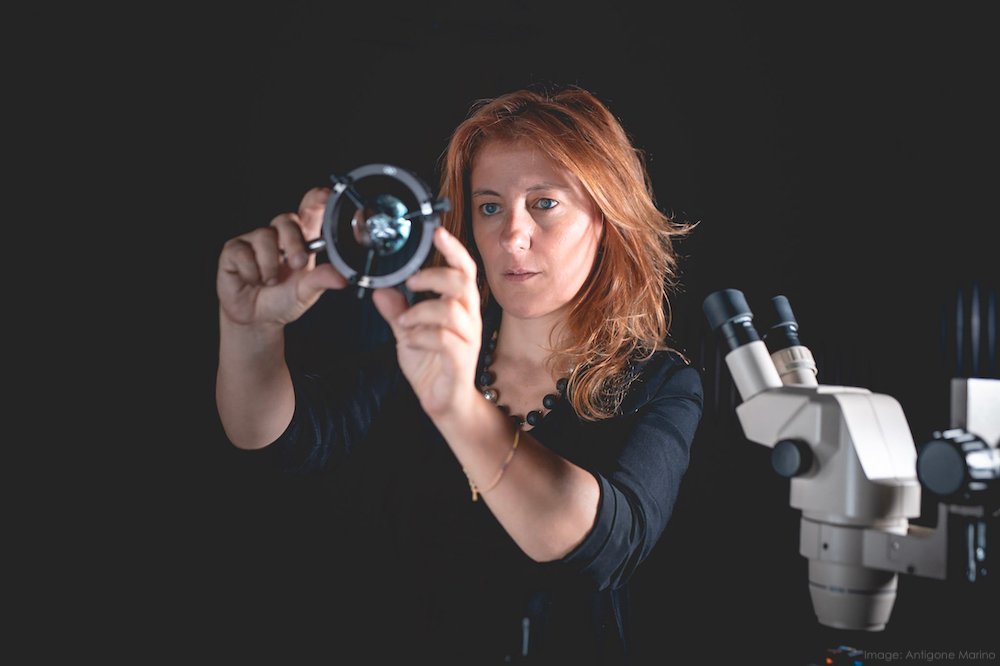
Growing Through Responsibility: my EPS Young Minds adventure
Author: Antigone Marino Back in 2010, I had the chance to be one of three physicists who, together with the European Physical Society (EPS), launched the EPS Young Minds. At the time, the idea was simple but bold: give young physicists a real voice in Europe, help them connect across borders, and support professional growth beyond the usual academic track. Things really stepped up a level when I became Chair of EPS Young Minds from 2013 to 2016. Suddenly, it wasn’t just about having good ideas anymore. It was about making things happen. That meant moving outside the comfort zone of scientific research and into leadership, coordination, and long-term strategy. As Chair, I was juggling quite a few responsibilities: coordinating national Young Minds sections across Europe, acting as a bridge between early-career physicists and the EPS leadership, and helping define the overall direction of the initiative. In practice, this meant a lot of meetings, a lot of discussions with people coming from very different backgrounds, and a lot of work turning ideas into actual, concrete actions at a European level. And being honest, a lot of effort went into finding funding to keep the project growing. What made Young Minds truly special was its place inside EPS, a federation of national physical societies. Across Europe there were already many initiatives by young physicists, but YM had to speak many “languages”: not just spoken ones, but also the very different ways national societies approach youth policies. It wasn’t always easy, but it was incredibly enriching. That challenge gave me a view of European physics I’d never had before. I learned how to negotiate, how to really listen, and how to build consensus in a multicultural environment. To this day, I see this as one of the most important things YM and EPS gave me. Along the way, EPS Young Minds connected me with an amazing network: motivated young researchers, senior scientists, policymakers, and professionals working at the intersection of science, education, and society. Those connections opened doors, sparked collaborations, and helped me see that a career in physics can take many different (and unexpected) paths. So, to any young physicist wondering whether getting involved in EPS or Young Minds is worth it: yes, absolutely. Do it even if it feels demanding. Do it especially if it feels unfamiliar. These experiences expand your horizons, multiply your opportunities, and give you skills that stay with you long after a specific role ends. Seeing Young Minds continue to grow today gives me a quiet sense of pride. Leaving a project is never easy; letting go is hard. But watching others take care of something that started as your dream? That’s one of the most rewarding feelings you can have in a career.
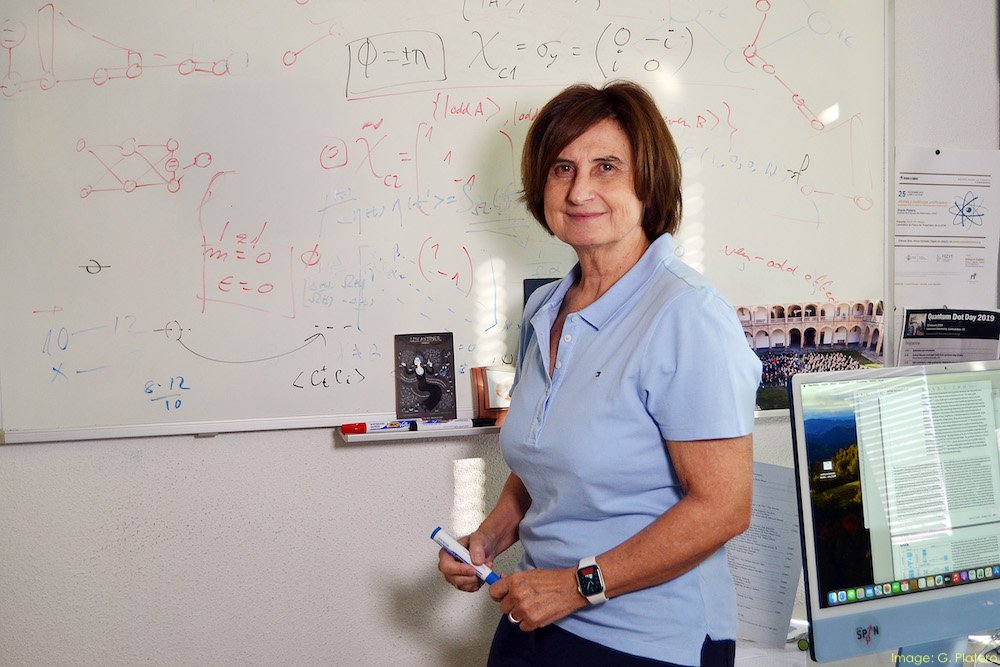
An interview with Gloria Platero
Gloria Platero, research professor at the Materials Science Institute of Madrid of the Spanish National Research Council (CSIC), was awarded the 2023 EPS Emmy Noether Distinction “in recognition of her remarkable contributions to the theoretical understanding of out-of-equilibrium (Floquet) systems and their impactful application to quantum materials, for her excellent mentorship of young researchers, and for tirelessly fostering female talent in physics.” Petra Rudolf, chair of the EPS Equal Opportunities Committee, interviewed Prof. Platero. How did you decide for a career in physics? I grew up in a home where science was part of everyday life. My mother was a mathematician, and my father, an engineer with a deep love for physics. So my curiosity and appreciation for science were encouraged from a very young age. At high school, I had an exceptional chemistry teacher who truly nurtured my curiosity and always encouraged me to ask questions and dig deeper. That experience made me want to understand more about atoms and ultimately led me to choose physics. Interestingly, my physics teacher at the time didn’t think that girls should study physics – but I was determined to follow my own path. When I began my studies at university, Spain was still under the Franco regime—a period marked by conservative attitudes and traditional gender roles. Female role models in physics were virtually nonexistent. During my doctoral research at the Autonomous University of Madrid, we were only two women among all the physics PhD students. It was a lonely place to be at times, but it also made me resilient. How is it for current female physics students and starting academics? There has certainly been progress. We now see more women entering physics in Spain, and the overall atmosphere is more welcoming. However, as you move up the academic ladder, the number of women goes down. The so-called “scissor diagram” still applies, and the upper levels of academia remain male-dominated. Unfortunately, this is not unique to Spain. Even in Northern European countries, which lead in gender equality according to the 2024 World Economic Forum report, the proportion of women professors in physics is still far below where it should be. In countries like Japan, the numbers remain dramatically low. It’s not only a question of representation—visibility also matters. Women in physics are often less visible in leadership roles and high-profile events. Additionally, we’re often burdened with a heavier share of committee work, which can detract from research time. That said, I want to be clear: I do not want to complain. I consider myself incredibly fortunate to have had such a fulfilling career. Working as a physicist is deeply gratifying. To my younger female colleagues, I would say: Don’t stay in the shadow of a famous supervisor, even if it feels safe or convenient. Step forward and show the world what you can do. It’s essential to carve out your own space and voice in science. Start by asking questions at conferences! I would also like to emphasize how important it is to share your life with someone who supports your career. In my case, my husband — though not a scientist but an engineer — has always been a strong and unwavering source of support. What do you recommend the physics community does to foster diversity? We all need to take a more active role in mentoring and supporting the next generation. Sharing our experiences—both successes and setbacks—is crucial. As a community, we should pay close attention to the representation of women and other underrepresented groups at conferences and workshops. We must advocate for talented colleagues to be included in speaker line-ups and panel discussions. Organisers should also make conferences more inclusive by offering childcare facilities and structured networking opportunities for women in physics. These seemingly small actions can make a big difference in building confidence and fostering a sense of belonging. As PhD supervisors, we should speak honestly with our students—not just about the excitement of doing physics, but also about the realities of academic life. It’s important to highlight that the so-called “alpha personalities” in our field are not always the happiest and most fulfilled, no matter how much recognition they receive. We must encourage our students to build a career path that gives them energy and joy—to find their own resonance state, so to speak. If they’re unhappy or feel stifled, it’s perfectly valid to change supervisors or move to another institution. We should give our PhD candidates opportunities to attend schools and conferences to build their networks. In the last phase of the doctoral work they should take on responsibilities like helping with the supervision of younger students. They should feel like what they are: essential members of the team. And one more very important thing: in our working life, we should be kind to each other, celebrate our colleagues’ successes, and foster an environment where support and appreciation are the norm.
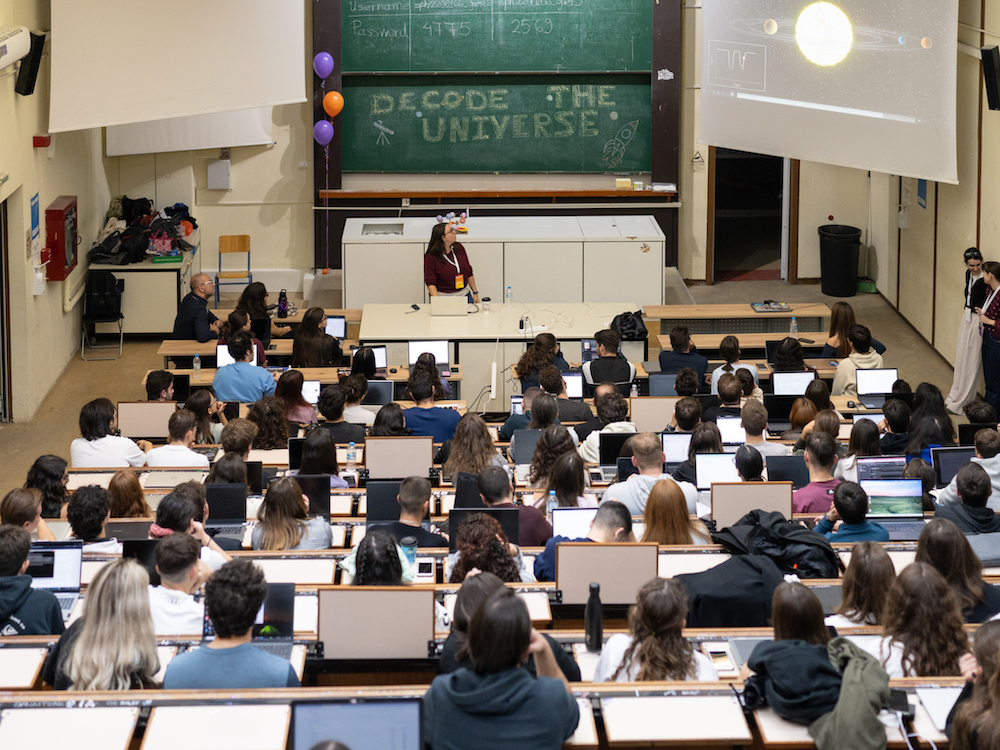
Decode The Universe-Exploring Exoplanets Through Data & Code
Authors: EPS Young Minds NKUA Section On November 3rd, Young Minds NKUA organised the event “Decode The Universe”, an interactive event that brought together astrophysics, programming, and hands-on experimentation at the Department of Physics of the National and Kapodistrian University of Athens. The event welcomed nearly 100 participants, reflecting the strong interest of students in computational astrophysics and modern data analysis. The event was co-organised with City Lab Robotics and supported by the Department of Physics NKUA. It combined theoretical insight with practical engagement, aiming not only to inform but also to actively involve participants in the scientific process. The programme began with a series of short talks οn robotics applications and data analysis methods used in exoplanet detection. Young Minds NKUA presented its mission and previous science communication projects, highlighting opportunities for student involvement. Dr. Kosmas Gazeas, astrophysicist and lecturer, welcomed participants and introduced the systems of the Gerostathopoulion Observatory. The core of the event was a hands-on workshop where participants analysed real astronomical-style datasets. Using code based on the Discrete Fourier Transform (DFT) and the Lomb–Scargle method, they calculated the orbital periods of exoplanets. The event concluded with an interactive Kahoot quiz on physics and a live demonstration of the Observatory’s automated systems. Prizes were awarded to the top participants, further enhancing engagement and motivation. Decode The Universe successfully combined theory, computational tools, and experiential learning. By immersing students in scientific techniques, the event strengthened their understanding of astrophysical data analysis while fostering enthusiasm for research and collaboration within the physics community.