Authors: Ian Bearden, Alessandra Fantoni, Alfredo Portone, Mairi Sakellariadou
This conference was organised by the European Physical Society (EPS) with the aim of exploring how advances in physics are shaping the future of energy systems. Experts from academia, industry, and public policy examined and discussed the scientific, technological, and societal dimensions of the energy transition. The event provided a unique opportunity to engage directly with leading experts in physics and energy research, fostering the exchange of ideas across disciplines and sectors. Participants gained valuable insight into the scientific advances underpinning the energy transition, while contributing to a high-level European forum dedicated to interdisciplinary collaboration. The conference took place on April 13 and 14 at the Palais des Académies in Brussels, with approximately 60 registered participants. The programme comprised three main sessions on Energy Generation, Storage, and Distribution, each followed by a dedicated panel discussion. Two additional invited speakers contributed with keynote presentations outside the main sessions.
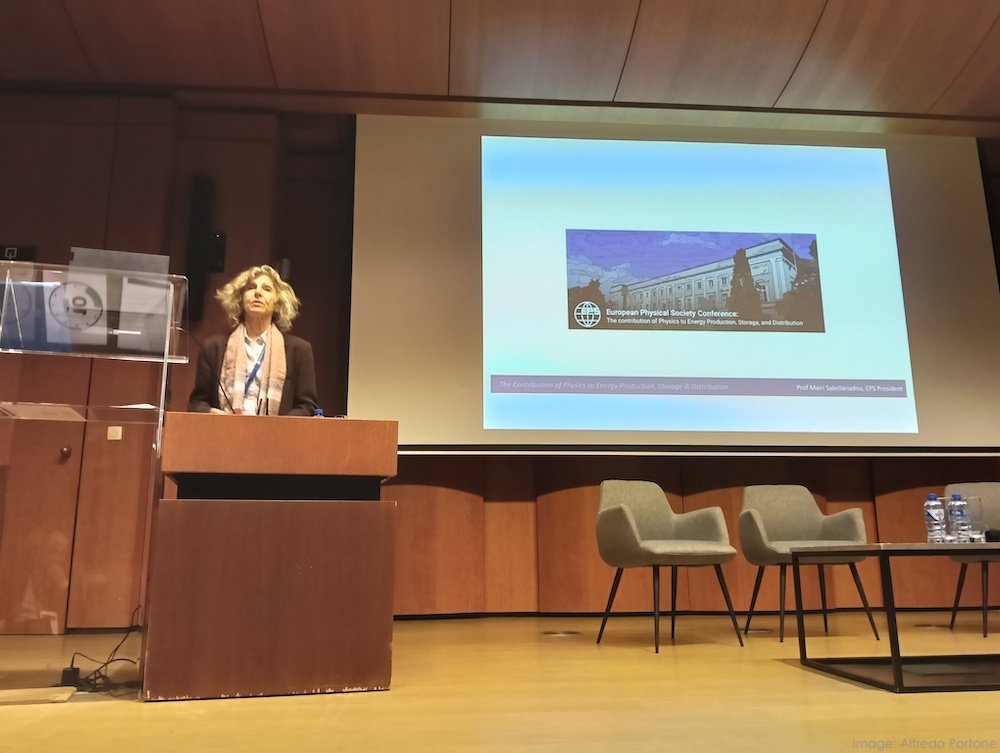
EPS President Prof Dr Mairi Sakellariadou opened the conference, welcoming participants and outlining its scope, while highlighting its connection to the recently published EPS position paper on energy. She emphasised that energy is a cornerstone of economic development and societal stability, and that effective energy policies must strike a balance between security of supply, affordability, and environmental sustainability.
The first day featured two sessions on Generation and Storage, each including three invited speakers and followed by panel discussions moderated by Laban Coblentz, Head of Communication of ITER. The day concluded with a keynote presentation by Dr Pietro Barabaschi, Director-General of the ITER Project, who provided an overview of the project’s current status.
On the second day, the session on Energy Distribution included three invited speakers and a panel discussion moderated by Dr Luca Romano. This was followed by a presentation from Dr Gianfranco Brunetti, Head of Unit at DG ENER, who illustrated the European Commission’s perspective on nuclear energy, waste management, and decommissioning.
The conference concluded with closing remarks by Prof Dr Mairi Sakellariadou, who summarised the main insights and thanked all contributors for the high quality of the discussions.
The key takeaways from the two-day conference can be summarised as follows:
– Energy emerged as a fundamental driver of civilisational progress and a central factor in geopolitical dynamics. The distribution of energy resources plays a crucial role both in societal advancement and, from an ethical perspective, in promoting global equity. Throughout the discussions, the deep interconnection between equity, energy security, and sustainability was consistently highlighted.
– Politicians are rarely elected based on long-term vision, a reality that potentially places political priorities in direct conflict with the requirements of a prudent energy transition. This challenge gave prominence, throughout various panel discussions, to the recurring theme of ethics as a fundamental value that should be integrated into decision-making processes.
– Closely linked to ethics is the role of human behaviour. As noted by Prof Dr Carlos Lledo Fernandez, society already possesses vast amounts of materials within existing batteries and electronics, provided that effective recycling practices are adopted. This insight shifts the focus from purely technological solutions to behavioural change, raising the question of how clear guidance and well-designed incentives could encourage responsible recycling across all stages of battery lifecycles. While regulation remains essential, complementary incentive mechanisms may be equally important in fostering widespread participation.
– In the field of nuclear energy, it was noted that fission produces substantial amounts of energy alongside high-level radioactive waste, much of which could potentially be recycled or reprocessed. Advanced techniques, such as neutron-induced transmutation, offer the possibility of converting hazardous isotopes into less harmful forms, thereby reducing long-term risks while contributing to additional energy generation.
– Regarding solar technologies, a specific point has been raised on perovskite-silicon cells: while they represent an important technological advancement, they may not constitute the transformative breakthrough often anticipated, as their development is already approaching expected practical performance levels.
– Electrical energy distribution was identified as a critical area requiring further research and innovation. Key challenges include the trade-offs between HVDC (High Voltage Direct Current, more expensive but suitable for underground transmission) and HVAC systems (High Voltage Alternate Current, less costly but associated with higher reactive power losses), the need to replace sulphur hexafluoride as an insulating medium, and the importance of voltage and frequency compensation technologies such as synchronous condensers and reactors.
– The benefits of enhanced energy interconnections were illustrated through the case of Ireland, where strengthened links with the United Kingdom and France are enabling a higher share of renewable energy. At the same time, the importance of transparent communication regarding infrastructure costs was emphasised, as these are often underestimated in public discourse.
– The Spanish blackout of 28 April 2025 was analysed as a case study in grid vulnerability. The event was triggered by a major overvoltage episode in a system already operating with limited stability margins, including low effective inertia due to high solar penetration and insufficient synchronous voltage control. The discussions emphasised that grid resilience must account not only for national-level inertia and stability, but also for the conditions of local network segments, where vulnerabilities can significantly amplify wider system disturbances
– During the panel discussion, several key themes emerged. Participants stressed the need for clearer and more effective communication with the general public, who often have limited awareness of grid infrastructure, balancing requirements, compensation mechanisms, and the associated costs. The fundamental role of physics was strongly emphasised—not only in advancing frontier research, but also in modelling and understanding increasingly complex energy systems. In addition, the importance of sustained research into more efficient, higher-capacity, and energy-dense storage solutions was repeatedly highlighted as essential for the future stability and sustainability of energy systems.
A final shared conclusion strongly emphasised that scientists, and physicists in particular, have an important voice of authority in society regarding energy, comparable in many respects to that of medical professionals in public health. As such, they can play a crucial role in improving the quality of public and political discourse on energy by reinforcing two essential principles for comparing energy sources:
– first, discussions must maintain consistency when distinguishing between installed capacity and actual energy generation or consumption, a distinction that is often blurred or misrepresented, particularly in debates surrounding renewable energy;
– second, meaningful comparisons between energy technologies must adopt a full life-cycle perspective, considering every stage from raw material extraction and manufacturing to operation, disposal, and potential recycling. This comprehensive approach is essential for informed, scientifically grounded, and ethically responsible energy decision-making.