Mulhouse, 10th April 2026. The European Physical Society is pleased to announce that
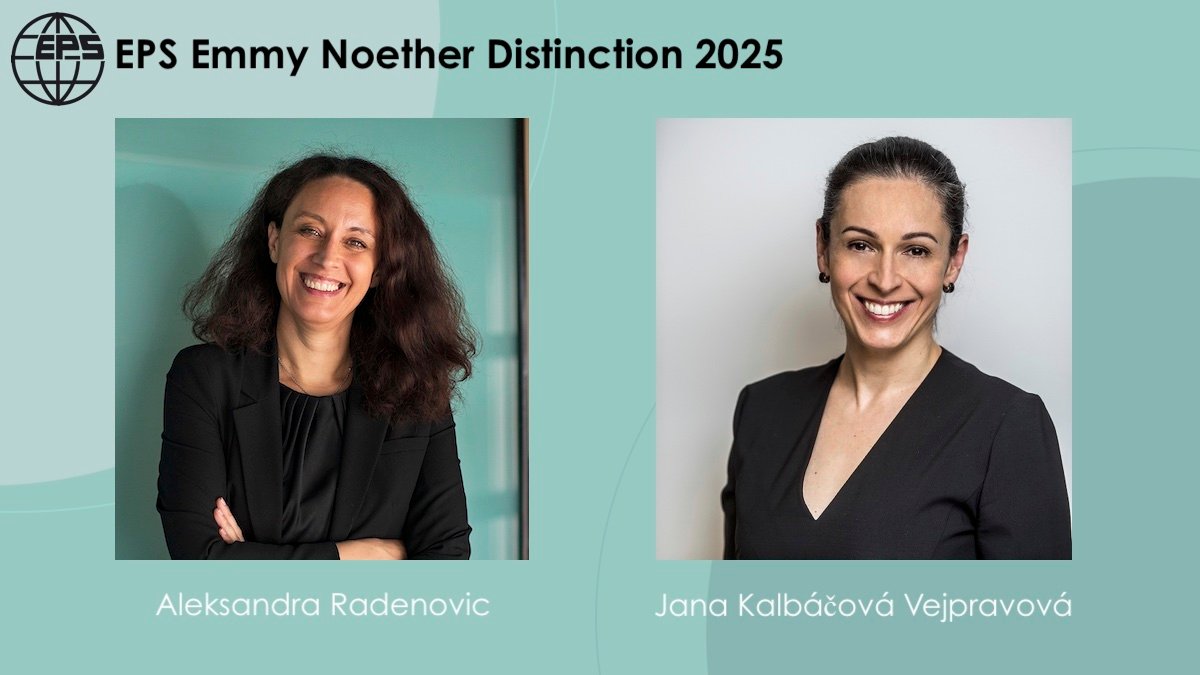
- Aleksandra Radenovic, head of Laboratory of Nanoscale Biology at the École Polytechnique Fédérale de Lausanne, is the laureate of the EPS Emmy Noether Distinction 2025 (full career) “for her groundbreaking contributions to the fields of nanopore science and nanofluidics that have advanced both physics and biology, as well as for as well as for her exemplary leadership in the scientific community, her commitment to mentoring and career development, and her sustained efforts to promote diversity and support women in science.”
- Jana Kalbáčová Vejpravová of the Faculty of Mathematics and Physics, Charles University, Prague, Czech Republic is awarded the EPS Emmy Noether Distinction 2025 (mid-career) “in recognition of her pioneering experimental research on nanomaterials, her influential role in shaping international science through outstanding collaboration, and her enduring commitment to gender equality and empowerment of women in physics.”
Aleksandra Radenovic, a Swiss and Croatian biophysicist, is a full professor of Biological Engineering in the School of Engineering and Co-Director of Bioengineering Institute. Professor Radenovic studied physics at the University of Zagreb (Croatia), finishing with a thesis on Raman spectroscopy of betacarotene, and received her Ph.D. in Biophysics from the University of Lausanne (Switzerland) in 2003 with a dissertation entitled “Development of low-temperature atomic force microscope for biological applications”. She spent 3 years as a postdoctoral fellow at the University of California, Berkeley, and before joining EPFL, she also worked at the National Institute of Dental and Craniofacial Research of the NIH, Bethesda, Maryland, and at Janelia Farm in Ashburn, Virginia.
Professor Radenovic is a leading figure of her generation in nanofluidics and nanoscale bioanalytical physics, whose work has fundamentally advanced the use of two-dimensional materials for single-molecule sensing, energy conversion, and neuromorphic systems. Her research is characterised by exceptional originality, breadth, and experimental sophistication, bridging nanotechnology, biophysics, photonics, and materials science.
Her scientific impact is marked by several transformative breakthroughs. She pioneered the use of molybdenum disulfide (MoS₂) nanopores and membranes, demonstrating their unique ion selectivity and enabling applications ranging from single-molecule biosensing and DNA analysis to osmotic energy harvesting and desalination. Her work revealed unprecedented efficiencies in nanofluidic power generation and uncovered novel transport phenomena, including ionic Coulomb blockade. Beyond sensing, she has opened new directions towards nanofluidic memristive devices and ionic neural networks for brain-inspired computation.
Equally groundbreaking is her development of advanced experimental methodologies. She introduced innovative single-molecule localisation microscopy approaches based on defect emitters, enabling, for the first time, direct visualisation of proton transport dynamics on two-dimensional materials. In parallel, she developed glass nanocapillary and nanopipette techniques combined with scanning ion conductance microscopy, achieving unprecedented spatial resolution in probing biomolecular interactions.
Alongside her scientific research, Aleksandra Radenovic has been a member of many selection panels of funding agencies and research institutions, assumed important editorial tasks, and served as President of the Swiss Biophysical Society (2019-2023). She devoted considerable time to mentoring, for example, in the Swiss-Croatian Tenure Track Pilot Program and led initiatives promoting diversity and gender equality. As President of the EPFL-Women-in-Science-and-Humanities Foundation, she advocates for and supports women in research. The foundation provides a mental and financial push to women researchers at key moments in their paths, organises networking events, and presents the annual Erna Hamburger Award, recognizing the most outstanding and influential women in science, serving as role models. When serving as President of the EPFL School assembly, she promoted bottom-up approach in addressing the needs of the diverse student population at EPFL.
Jana Kalbáčová Vejpravová studied chemistry at Charles University in Prague before transitioning to condensed matter physics and materials research, obtaining her PhD there in 2007 with a thesis entitled Impurities in Rare Earth Metallic Systems: from Super-Purified Metals to Heavy Fermion Superconductors. Following postdoctoral appointments at Hasselt University (Belgium) and the National Institute for Materials Science in Tsukuba (Japan), she served as Head of Department at the Institute of Physics of the Czech Academy of Sciences (2011–2017). She subsequently returned to Charles University, where she is now Full Professor (since 2021), Chair of the Doctoral School “Physics of Nanostructures and Nanomaterials”, and group leader at the Department of Condensed Matter Physics.
Her research focuses on the experimental physics of low-dimensional systems—including carbon nanotubes, graphene, other two-dimensional materials, and magnetic nanoparticles—with particular emphasis on advanced magnetometry and cryogenic magneto-optical and nuclear spectroscopies. Professor Vejpravová has established a world-leading programme in high-precision magneto-optical measurements. Her laboratory is among the very few worldwide capable of combining high magnetic fields with cryogenic magneto-optical spectroscopy, including magneto-Raman and chiral photoluminescence, enabling the disentanglement of spin and valley interactions in emerging quantum materials. Her work has delivered fundamental insights into electron interactions, notably exciton–lattice dynamics, and has advanced the field by moving from idealised systems to realistic mesoscopic platforms such as folded transition metal dichalcogenides and isotope-engineered van der Waals heterostructures.
Beyond her scientific achievements, Professor Vejpravová is a committed advocate for gender equality and an outstanding mentor. She has actively worked to dismantle structural barriers for women in physics, notably through sustained collaborations with leading female scientists in Taiwan (NTU, NTNU, Academia Sinica), enhancing the visibility and impact of women researchers internationally. Her leadership has been recognised by her inclusion among the Forbes Top Female Researchers in Czechia (2023).
She has supervised more than 30 early-career researchers and plays a central role in graduate education. She has led or co-managed around twenty competitive research projects, including an ERC Starting Grant, and serves on numerous international evaluation panels and scientific boards. Through outreach activities, policy engagement, and media contributions, she promotes science to wider audiences. For these efforts, she was awarded the F. Behounek Award by the Czech Ministry of Education, Youth and Sport for the promotion of Czech science.
More info