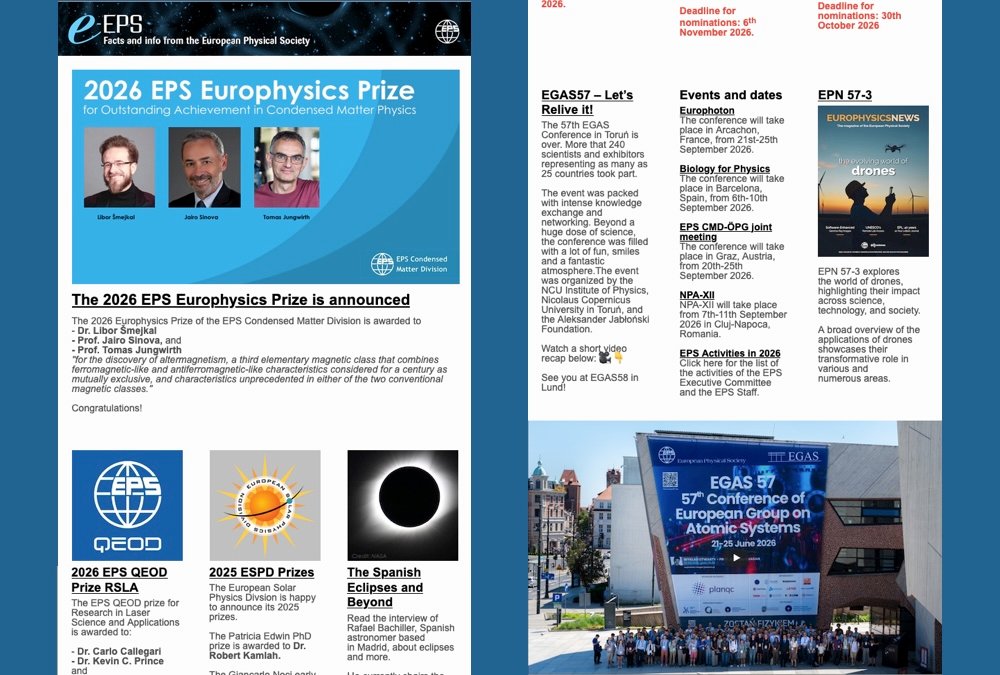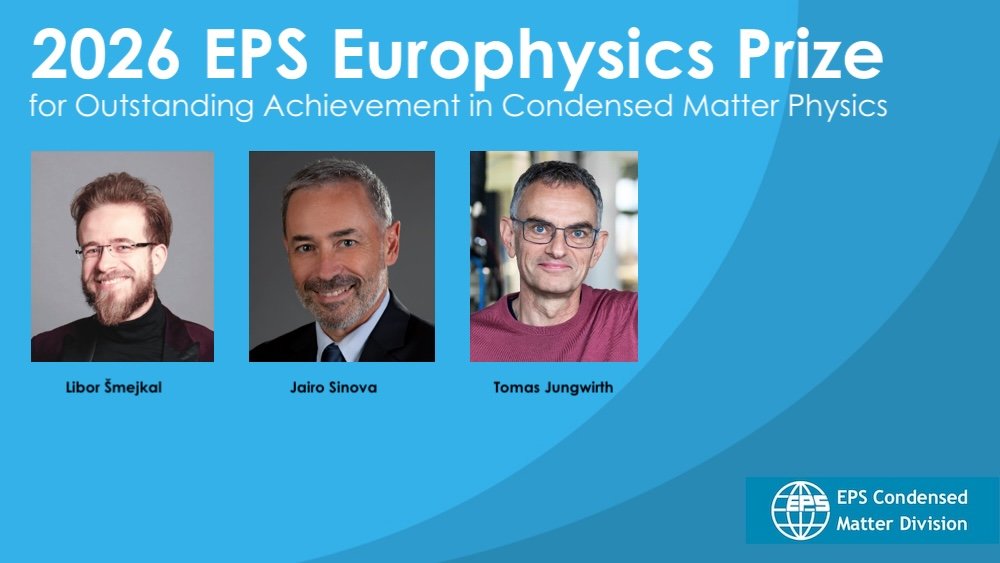
The 2026 Europhysics Prize of the EPS Condensed Matter Division is awarded to Dr. Libor Šmejkal, Prof. Jairo Sinova, and Prof. Tomas Jungwirth for the discovery of altermagnetism, a third elementary magnetic class that combines ferromagnetic-like and antiferromagnetic-like characteristics considered for a century as mutually exclusive, and characteristics unprecedented in either of the two conventional magnetic classes.
The Prize will be presented on Tuesday September 22nd 2026, during the Awards Session of the 32nd General Conference of the EPS Condensed Matter Division (CMD32), in Graz organised jointly with the Austrian Physical Society. The Europhysics Prize has been awarded since 1975 (this is the 42nd edition) and is one of Europe’s most prestigious prizes in the field of condensed matter physics. It is awarded in recognition of a prominent and well-identifiable discovery, breakthrough, or contribution to condensed matter physics, by one or more individuals, a contribution that, in the opinion of the selection committee, represents scientific excellence. The award recognizes research for which a significant portion of the work was carried out in Europe. A summary of all the prize editions can be found here.
For more than a century, scientists believed that all magnetic materials belonged to one of two basic classes: ferromagnets, familiar from everyday magnets and used in hard drives and electric motors, and antiferromagnets, in which opposing magnetic moments cancel each other. The discovery of altermagnetism revealed that nature contains a third distinct elementary magnetic phase, one that combines seemingly incompatible properties of both ferromagnets and antiferromagnets whilst exhibiting entirely different quantum phenomena.
This discovery has fundamentally changed the way we classify magnetic materials – requiring a rewriting of the introductory chapters of magnetism textbooks – and has launched an entirely new research field of unconventional magnetism with many implications in other areas of condensed matter physics.
Although the discovery represents a landmark in basic physics, it has transformative technological potential. Modern electronics increasingly seeks to exploit not only the electric charge of electrons but also their spin, enabling devices that are faster, consume less energy, and process information in entirely new ways. Until now, researchers faced a difficult compromise. Ferromagnets generate the spin-polarized currents required for spintronic devices but produce stray magnetic fields that hinder miniaturization. Antiferromagnets eliminate these stray fields and operate naturally at ultrafast terahertz frequencies, but they generally lack the strong spin-polarized currents and electrical control required for many spintronic applications.
Altermagnets combine the best of both worlds. They possess no net magnetization, eliminating magnetic cross-talk between neighboring devices, while naturally generating strong spin-polarized currents capable of operating at ultrafast terahertz frequencies. These properties provide a path towards ultrafast and ultra-energy-efficient computer memories, with significant potential for future high-performance computing and AI hardware.
Perhaps even more remarkably, altermagnetism is proving to be much more than an unconventional type of magnet. Its underlying alternating spin-polarized order represents the magnetic counterpart of unconventional superconducting order. More generally, by revealing a previously overlooked symmetry class of magnetic matter, the discovery is providing theorists and experimentalists with a powerful new lens through which to explore the quantum world. This emerging spin-symmetry framework is rapidly becoming useful for describing a wide range of quantum materials. Researchers have already uncovered implications for superconducting, strongly correlated, multiferroic, and topological materials, establishing fundamental conceptual links between some of the most active research areas in modern condensed matter physics.
The breakthrough emerged from a long-standing collaboration between the three laureates, who had been searching for magnetic materials capable of producing highly spin-polarized electrical currents without the drawbacks of conventional magnets. Their theoretical work first predicted several unusual electronic transport phenomena, including low dissipation transverse electrical currents, before revealing that these materials belonged not to an exotic subclass of antiferromagnets, but to an entirely distinct elementary magnetic phase.
Their symmetry-based classification immediately identified more than 200 candidate materials, providing researchers worldwide with a roadmap for experimental exploration. Within only a few years, multiple international teams confirmed the predictions, culminating in direct observations of the characteristic electronic structure in materials including MnTe and CrSb.
Today, altermagnetism has become one of the most rapidly expanding areas of condensed matter physics. The original papers have inspired more than a thousand subsequent studies and have drawn researchers from disciplines ranging from magnetism and superconductivity to quantum materials and materials science. The discovery and conceptual development of altermagnetism have been led by European researchers, establishing Europe as the birthplace of this emerging field. The breakthrough has since stimulated rapidly growing research efforts worldwide, including major initiatives in the United States, Japan, and across Asia.

FLTR: Dr. Libor Šmejkal (Max Planck Institute for the Physics of Complex Systems, Max Planck Institute for Chemical Physics of Solids, and Institute of Physics of the Czech Academy of Sciences) – © Šmejkal
Prof. Jairo Sinova (Johannes Gutenberg-Universität Mainz, Germany and Texas A&M University, USA) – © Sinova
Prof. Tomas Jungwirth (Institute of Physics of the Czech Academy of Sciences, University of Nottingham UK, and Tohoku University, Japan) – © Jungwirth