General Description
The European Physical Society (EPS), through its Nuclear Physics Division (NPD) Board, awards the Lise Meitner Prize to one or more researchers who have made outstanding contributions to nuclear science. Such contributions may comprise experimental nuclear physics, theoretical nuclear physics and all areas of application of nuclear science.
The board welcomes proposals which represent the breadth and the strength of European nuclear science.
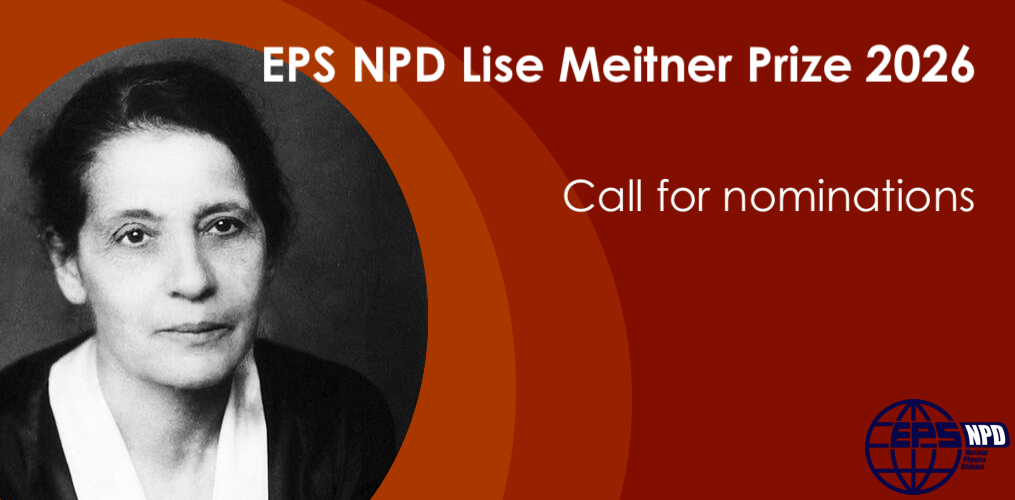
The Prize is named after Lise Meitner to honor her fundamental contributions to nuclear science and her courageous and exemplary life.
Call for Nominations
The call for nominations for the 2026 Lise Meitner Prize is open.
Nominations should be submitted through this website: Lise Meitner Prize 2026 Nominations
Nominations should be accompanied by a complete nomination form, a short description of the achievements of the nominee(s), a brief curriculum vitae of the nominee(s), a list of major publications and eventually letters of support from authorities in the field.
Nominations will be treated in strict confidence. While all nominations will be acknowledged, there will be no further communication from the selection committee, till the announcement of the prize winner.
2026 Lise Meitner Prize Committee contact person: araceli.lopez-martens@ijclab.in2p3.fr
Deadline for submission of nomination: The deadline for submission of nomination is November 6th 2026.
Award ceremony: The Lise Meitner prize will be awarded at the next edition of the European Nuclear Physics Conference, which will take place in Catania from the 12th to the 17th of September 2027.
Prize Rules
· The Prize should consist of a Diploma, a Medal with the image of Lise Meitner and 5000 €.
· The money for the Prize will be provided by sponsors.
· The Prize shall be awarded every two years.
· The Prize shall be awarded to one or more researchers (in the latter case the prize will be shared between the laureates).
· The Prize shall be awarded without restrictions of nationality, sex, race or religion.
· Only work that has been published in peer-reviewed journals can be considered in the evaluation of nominations.
· Call for nominations will be published on EPS website.
· Self-nominations shall not be accepted.
· Nominations shall be reviewed by a Prize Committee appointed by the NPD board. The Committee shall consider each of the eligible nominations and shall make recommendations to the NPD board, taking into account possible reports of referees who are not members of the Board.
· The final recommendation of the NPD board and a report should be submitted for ratification to the Executive Committee of EPS.
The EPS NPD wishes to recognise excellence in nuclear physics and would like to receive nominations which reflect the diversity of the EPS community.
The winner(s) will present the work and be awarded the Lise Meitner Prize 2026 at the European Nuclear Physics Conference (EuNPC 2027), which will be held in Catania (Italy) from September 12th to 17th, 2027.
Sponsors
The 2026 Lise Meitner Prize is sponsored by:
. Forschungszentrum Jülich
. IFIN-HH
· IJCLab Laboratoire de Physique des 2 Infinis Irène Joliot-Curie, Orsay
. INFN Laboratori Nazionali di Frascati
. INFN Laboratori Nazionali di Legnaro
. INFN Laboratori Nazionali del Sud
. JYFL Department of Physics of the University of Jyväskylä
Lise Meitner Prize Winners
2024: Muhsin N. Harakeh (University of Groningen – Netherlands) and Achim Richter (Technical University of Darmstadt – Germany) for their seminal contributions to the discovery and investigation of collective modes in atomic nuclei, including the Isoscalar Giant Monopole and Dipole Resonances and the «Scissors Mode», and the role of the isospin degree of freedom in nuclear excitations. Their work has also driven significant methodological advancements, such as zero-degree measurement techniques and the development of multi-turn superconducting linear accelerators.
2022: Philip Walker (University of Surrey, United Kingdom) for his outstanding developments in the study and understanding of isomeric states including critical insights into possible isomer applications, such as energy storage and coherent gamma-ray emission. He has also led in the development and exploitation of a range of experimental techniques, from low-energy isotope separators to high-energy storage rings, which will also extend the isomer research opportunities with the new generation of radioactive-beam facilities.
2020: Björn Jonson (Chalmers University of Technology, Gothenburg, Sweden), Piet Van Duppen (KU Leuven, Belgium) and Klaus Blaum (Max-Planck-Institute for Nuclear Physics, Heidelberg, Germany) for their development and application of on-line instrumentation and techniques, for their precise and systematic investigation of properties of nuclei far from stability, and for shaping the scientific program at the online isotope separator facility ISOLDE, CERN.
2018: Peter Ring (Technische Universität München, Germany) for his microscopic description of high-spin phenomena and collective vibrations in nuclei, and developed the theory of relativistic nuclear energy density functionals and Peter Schuck (Institut de Physique Nucléaire d’Orsay and Laboratoire de Physique et Modélisation des Milieux Condensés of Grenoble, France) for his new approaches for nuclear matter in connection with nuclear superfluidity. His studies on alpha-particle condensation motivated a wealth of experimental studies on the structure of alpha clusters.
2016: Ulf-G. Meißner (Rheinische Friedrich-Wilhelms-Universität Bonn and Forschungszentrum Jülich, Germany) for his developments and applications of effective field theories in hadron and nuclear physics, that allowed for systematic and precise investigations of the structure and dynamics of nucleons and nuclei based on Quantum Chromodynamics.
2014: Johanna Stachel (Physikalisches Institut der Universität Heidelberg, Germany), Peter Braun-Munzinger (GSI, Germany), Paolo Giubellino (INFN Torino, Italy and CERN, Switzerland) and Jürgen Schukraft (CERN, Switzerland) for their outstanding contributions to the experimental exploration of the quark-gluon plasma using ultra-relativistic nucleus-nucleus collisions, in particular to the design and construction of ALICE and shaping its physics program and scientific results bringing to light unique and unexpected features of a deconfined state of strongly-interacting matter at the highest temperatures ever produced in the laboratory.
2012: Karlheinz Langanke (GSI and Technical University of Darmstadt, Germany) and Friedrich-Karl Thielemann (University of Basel, Switzerland) for their seminal contributions to the description of nuclear processes in astrophysical environments that have changed our modern understanding of stellar evolution, supernovae explosions and nucleosynthesis.
2010: Juha Äystö (Department of Physics, University of Jyväskylä, Finland) for accurate determination of fundamental nuclear properties by the invention of innovative methods of ion guidance and its applications to radioactive ion beams. Most of the work, and the development of the ion guide method in particular, have been performed at the cyclotron laboratories in Jyväskylä at both the old and the new Physics Departments.
2008: Reinhard Stock and Walter Greiner (Johann Wolfgang Goethe Universität and FIAS, Frankfurt, Germany). Reinhard Stock for his outstanding contributions to the development of the field of relativistic nucleus-nucleus collisions by initiating research through the innovative use of high-energy accelerators (BEVALAC at LBL, SPS at CERN) which indicated the existence of a new form of matter. Walter Greiner for his outstanding contributions to the development of the field of relativistic nucleus-nucleus collisions by pioneering the ideas of shock waves and collective flow in nuclear matter, thus inspiring experimental studies of nuclear matter at extreme conditions of density and temperature.
2006: Heinz-Jürgen Kluge (GSI, Germany) and David Brink (Department of Physics, Oxford, United Kingdom). Heinz-Jürgen Kluge for his key contributions to our knowledge of the masses, sizes, shapes and spins of nuclei through a number of decisive, sophisticated and brilliant experiments which combine atomic and nuclear physics techniques. David Brink for his many contributions to the theory of nuclear structure and nuclear reactions over several decades, including his seminal work on the theory of nuclear masses using Skyrme effective interactions, nuclear giant resonances, clustering in nuclei and quantum and semi-classical theories of heavy-ion scattering and reactions.
2004: Bent Herskind (Niels Bohr Institute, University of Copenhagen, Denmark) and Peter Twin (Department of Physics, The University of Liverpool, United Kingdom) for their pioneering development of experimental tools, methods of analysis and experimental discoveries concerning rapidly spinning nuclei, in particular the discovery of superdeformed bands in wide regions of the periodic table.
2002: James Philip Elliot (University of Sussex, Brighton, United Kingdom) and Francesco Iachello (Yale University, New Haven, USA) for their innovative applications of group theoretical methods to the understanding of atomic nuclei.
2000: Peter Armbruster (GSI, Germany), Gottfried Münzenberg (GSI, Germany) and Yuri Ts. Oganessian (Flerov Laboratory, Dubna, Russia) for their unique work over a long period on the synthesis of heavy elements, which has led to the discovery of the new elements in the region of nuclear charges of Z=102 to 105 (Dubnium), as well as Bohrium (Z=107), Hassium (Z=108) and Meitnerium (Z=109).