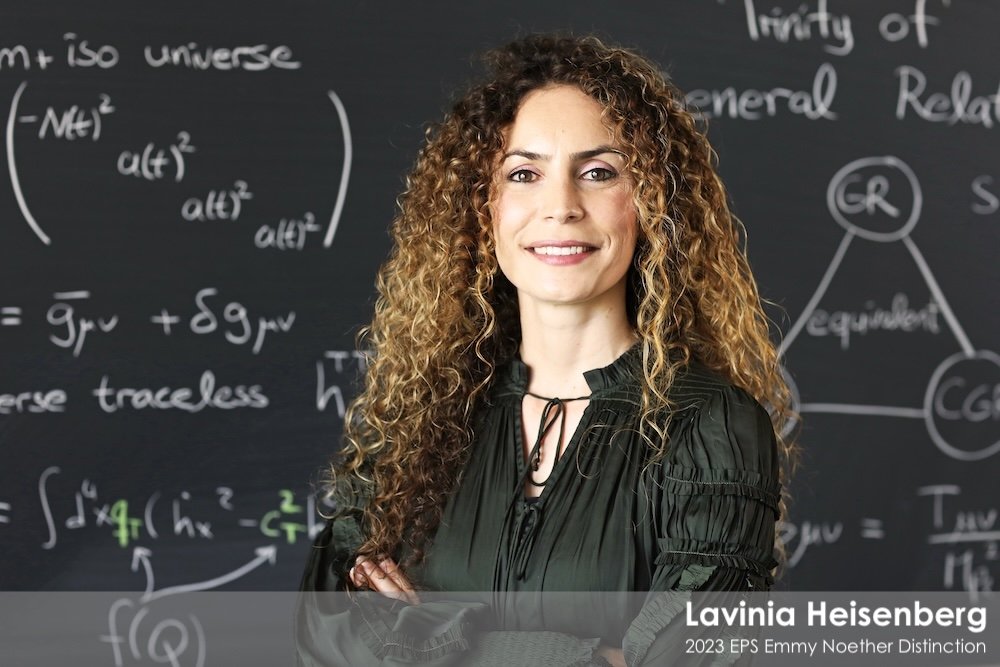
An interview with Professor Lavinia Heisenberg, 2023 EPS Emmy Noether Distinction laureate – Author: Petra Rudolf
What does it mean to understand gravity? How much can we trust our most successful theories? And what happens when we dare to question the framework that has shaped our understanding of the Universe for more than a century?
For Prof. Lavinia Heisenberg, these are not merely abstract questions. They are at the heart of her scientific journey. A professor of theoretical physics at Heidelberg University, Heisenberg works at the intersection of gravitational physics, cosmology and fundamental physics. Her research explores possible extensions of General Relativity and seeks to understand what gravity may be telling us about the deepest structure of the Universe. More recently, her interests have also reached into black-hole physics and gravitational waves.
Her work has earned her numerous distinctions, including the ETH Zurich Latsis Prize, the Buchalter Cosmology Prize, the Gustav-Hertz Prize of the German Physical Society and the General Physics Prize of the Swiss Physical Society. In 2023 she was selected as a mid-career laureate of the EPS Emmy Noether Distinction, recognising both her scientific contributions and her engagement for women in science and outstanding leadership.
You work on some of the deepest questions in physics. Where did your fascination with gravity begin?
I think it started with a very simple feeling of curiosity. As a child, I was fascinated by phenomena where you could observe an effect without seeing the underlying cause. I remember wondering why two magnets could repel each other even though there seemed to be nothing connecting them. Later, I became increasingly fascinated by astrophysical phenomena and by the Universe as a whole. There is something extraordinary about the fact that a relatively small set of fundamental laws can describe structures ranging from elementary particles to stars, black holes and the evolution of the entire Universe.
Gravity is particularly fascinating because it is simultaneously extremely familiar and profoundly mysterious. We experience it every second of our lives, yet when we ask what gravity actually is at the most fundamental level, we still encounter deep questions. That combination — something so familiar and yet so mysterious — is incredibly motivating.
You have described General Relativity as one of the great achievements of human thought. Why, then, do you want to go beyond it?
I would never describe the search for new theories as a rejection of General Relativity. Quite the opposite. General Relativity is one of the most beautiful and successful theories we have ever developed. But precisely because it is so successful, it provides us with an extraordinarily precise framework against which we can ask where the remaining mysteries are. We know that General Relativity and quantum mechanics do not yet fit together into a complete description of nature. We also know that our standard cosmological model contains profound puzzles concerning dark energy, dark matter and the evolution of the early Universe.
So the question is not simply, “Is Einstein wrong?” The much more interesting question is:
“What is the deeper theory of which General Relativity might be a limiting case?”
For me, that is where the real excitement begins.
Your work explores generalisations of General Relativity. What does that mean in more intuitive terms?
One way of thinking about it is that Einstein taught us that gravity is geometry: matter and energy influence the geometry of space-time, and that geometry determines how matter moves. We can then ask whether the geometry of space-time could have a richer structure than the one assumed in the simplest formulation of General Relativity.
In my work, I have explored theories in which additional geometric structures play a role. The aim is not to introduce complexity for its own sake. The real challenge is to find theories that are mathematically consistent, physically meaningful and testable. Ultimately, physics is an experimental science. A beautiful theory is only the beginning. We want to know whether nature actually chose it.
Cosmology has recently become particularly exciting, with tensions between different observations. Does this suggest that something fundamental may be missing?
It certainly makes the present period very interesting. We have an extraordinarily successful standard cosmological model, and at the same time we are seeing increasingly precise observations that challenge some of its details. The so-called Hubble tension is one prominent example, and there are other discrepancies that we are trying to understand.
What I find particularly interesting is that these tensions force us to look at the problem from several directions at once. Is there a problem with the observations? Is there new astrophysical physics that we do not yet understand? Or could there be something fundamental missing from our description of gravity or cosmology? We should keep all three possibilities open.
This is one reason why I find theoretical physics so exciting. Sometimes an inconsistency or a tension is not an inconvenience. It can be a clue.
You have also increasingly worked on black holes and gravitational waves. What makes these objects so compelling?
Black holes are remarkable because they push our theories to their limits. They are regions where gravity becomes extremely strong, and they connect several areas of fundamental physics: General Relativity, astrophysics, quantum theory and cosmology.
Gravitational waves have added another dimension to this story. We are no longer limited to observing the Universe through electromagnetic radiation. We can literally listen to ripples in space-time produced by some of the most violent events in the cosmos. This opens a completely new window on fundamental physics. And it gives us something that theorists desperately need: new ways of testing our ideas.
You are a theoretical physicist. What does a successful day of research actually look like?
There is probably no such thing as a typical day. Sometimes it is hours at a blackboard trying to understand one equation. Sometimes it is a discussion with a student or a collaborator that suddenly changes the way you think about a problem. Sometimes you spend days pursuing an idea that eventually turns out not to work. And that last part is important.
Science is not a straight line from question to discovery. You try things, you make mistakes, you become confused, you go back to the beginning, and occasionally you suddenly see something that you did not see before. Those moments are incredibly rewarding.
For me, one of the most beautiful aspects of theoretical physics is that a very abstract mathematical idea can eventually tell us something profound about the physical Universe.
Your work spans gravitational physics, cosmology, particle physics and astrophysics. Why is crossing disciplinary boundaries important to you?
Nature does not organise itself according to the boundaries that we have created between scientific disciplines. We divide physics into cosmology, particle physics, astrophysics and gravitational physics because it helps us organise knowledge. But the Universe itself does not care about these categories. Many of the most interesting questions arise precisely at the interfaces.
For example, if you want to understand the early Universe, you inevitably encounter particle physics. If you want to understand the late-time evolution of the Universe, you encounter cosmology and gravity. If you want to test strong-field gravity, black holes and gravitational waves become essential. I therefore believe strongly in maintaining a broad perspective. Sometimes the solution to a problem is found not by digging deeper into the same hole, but by looking sideways.
You have received a number of major scientific awards. What does recognition mean to you?
Awards are of course very gratifying, and I am deeply honoured by them. But scientific recognition is not what gets me up in the morning. What matters most to me is the science itself — having an interesting question, being surrounded by talented people and having the freedom to pursue an idea.
That said, the EPS Emmy Noether Distinction has a particularly special meaning. Emmy Noether was an extraordinary scientist. Her work transformed mathematics and theoretical physics, and her name is associated with one of the most profound connections in physics: the relationship between symmetries and conservation laws.
But there is also something deeply moving about receiving an award named after a woman who had to overcome enormous barriers simply to participate in academic life. So I see the distinction not only as a recognition of my own work, but also as part of a much larger story.
What does Emmy Noether represent to you personally?
She represents intellectual freedom. Noether did not simply solve problems within an established framework. She fundamentally changed the way we think about mathematics and physics. Her story also reminds us that scientific talent can be overlooked when the structures around us are not designed to recognise it.
That is why I think the Emmy Noether Distinction is particularly powerful. It says something very simple: we see you, we recognise your contribution, and we want the next generation to see that there is a place for them in physics.
The EPS recognised not only your research, but also your engagement for women in science. Why is this important to you?
Because talent is distributed much more widely than opportunity. Physics benefits enormously when we allow talented people from different backgrounds to contribute. If women, or people from other groups that have historically been underrepresented, do not see themselves reflected in the scientific community, we lose talent before it even has the opportunity to flourish.
I do not think the solution is simply to tell young women, “You can do physics.” We also have to build environments in which they genuinely can. That means good mentorship, fair evaluation, visible role models, supportive working environments and, importantly, giving young scientists the confidence to believe that they belong.
You have yourself become a role model. Is that a responsibility you consciously feel?
Yes. At some point I realised that the presence of a woman has an effect. If a young woman walks into a room and sees that there are women leading research groups, giving invited talks, making decisions and asking fundamental questions, it subtly changes what she imagines is possible. Representation matters.
And I think there is an important distinction here: we should not expect women to become role models because they are women. Scientists should be able to concentrate on being scientists. But if your visibility can help someone else imagine a future for themselves, then that is a wonderful consequence.
What would you say to a young woman who loves physics but is unsure whether she belongs in the field?
I would tell her: follow your curiosity.
Do not decide whether you belong in physics based on whether you fit an image of what a physicist is supposed to look like. Physics needs people who ask questions, people who are persistent, people who think differently, people who are creative, people who are mathematically inclined — and people who are willing to say, “I don’t understand this yet.”
You do not have to be the most confident person in the room. You simply have to remain curious enough to keep asking questions. And if you love the questions, that is already a very good reason to stay.
You have spoken about supporting women in physics. Was there ever a moment when you yourself were made to feel that you did not belong?
Yes. Unfortunately, there were several. At different stages of my career, I was advised by senior professors — all men — that I should reconsider studying physics, or that theoretical physics was perhaps not the right path for me, that I was not “good enough” that I was not “theoretical enough”, or that I was not “deep enough”. At other times, I had the feeling that I had to prove myself in situations where male colleagues were simply assumed to be competent.
I am very glad that I did not listen. But this experience has stayed with me. Because I sometimes wonder: What if I had believed them? I might never have become a professor. And that is the frightening part. There are undoubtedly many talented young women who leave science not because they lack ability, but because someone they respect convinces them that they do not belong.
Even today, although I have reached a position where I can open doors for others, I sometimes feel that I still have to prove myself more than my male colleagues. That is why I think role models and supportive mentors matter so much. Sometimes the most important thing you can tell a young scientist is simply: “You belong here. Keep going.”
You have also taken on leadership roles. What have you learned about leadership from being a scientist?
Science teaches you something very important about leadership: you cannot do everything yourself. The strongest research environments are those in which people feel that they can contribute their own ideas and challenge each other intellectually. As a leader, my goal is therefore not to have the smartest answers in the room. It is to create a room in which smart answers can emerge.
I also think that leadership in academia should ultimately be about creating opportunities for other people. If, years from now, students and postdocs who worked with me have built their own successful scientific careers, that will be one of the things I am proudest of.
You have received recognition for leadership as well as science. Do you see the two as connected?
Very much so. Science is increasingly collaborative. The big questions we are asking require different perspectives, different expertise and often international teams. Leadership is therefore not separate from scientific excellence. Creating an environment in which talented people can do their best science is itself a scientific contribution.
And there is another aspect that I find important: leadership means having the courage to take responsibility for the direction of a field, rather than simply following where the field is already going.
What do you think physics needs most at the moment?
Curiosity — and courage.
Curiosity to ask questions that may initially seem impossible. And courage to challenge assumptions that have worked extremely well. We should never abandon successful theories lightly. But we should also never confuse success with final truth.
Physics progresses because every generation is willing to ask: What have we not yet understood?
That is the question that keeps the field alive.
What is the biggest open question that you would personally love to see answered?
There are several candidates. I would love to understand the fundamental nature of dark energy. I would love to know what really happens when gravity and quantum mechanics meet. And I would love to understand whether the apparent tensions in cosmology are telling us something profound about the laws of nature.
But perhaps the deeper question is simpler: What is the fundamental structure of reality?
We have learned an astonishing amount about the Universe. Yet the more we learn, the more clearly we see how much remains unknown. That is not discouraging. For me, it is the most exciting thing about being a physicist.
You once said that you dream of becoming an astronaut. Is that still a dream?
Absolutely. There is something very special about seeing the Earth from space. As physicists, we spend our lives trying to understand the Universe from here. To actually leave the planet and look back at it would be an extraordinary experience. Perhaps one day.
If you could send one message to your younger self at the beginning of your scientific career, what would you say?
I would say: do not be afraid of not knowing.
When you are young, there can be a tendency to think that successful scientists know everything. They don’t. Science is fundamentally about discovering what we do not know. So uncertainty is not a weakness. It is where discovery begins.
And I would add one more thing: Be ambitious about the questions, but patient about the answers.
Some of the most interesting problems in physics take years — sometimes decades — to understand.
What would you like the next generation of physicists to inherit from your generation?
I would like them to inherit a scientific culture that is both ambitious and open. A culture where young researchers can ask difficult questions without being afraid of failure. Where collaboration is valued over competition when collaboration produces better science. Where women and men have equal opportunities to develop their careers. And where we remain willing to challenge even our most cherished ideas.
Physics has always advanced by changing the way we see the world. I hope the next generation will be even bolder than ours. Because somewhere beyond what we currently understand, there is almost certainly a more beautiful theory waiting to be discovered.
And finally: AI is transforming almost every aspect of society. What do you think it could mean for science — and for fundamental physics in particular?
I think we are at the beginning of a very profound transformation. AI should not simply be seen as a tool for making existing scientific workflows faster. Its real potential is much more exciting: it could change the way we discover scientific knowledge.
In physics, we are often faced with enormous spaces of possible theories, models, parameters and observations. Traditionally, we explore these spaces through analytical calculations, numerical simulations and human intuition. AI can help us navigate this complexity in ways that would be extremely difficult — or even impossible — for an individual researcher. I am particularly interested in what we might call Scientific AI: AI that is developed not merely to predict or automate, but to help us formulate hypotheses, identify hidden structures in data, discover useful approximations and perhaps even suggest new physical principles.
Imagine an AI system that is given fundamental principles, observational data and the requirement that a proposed theory must be mathematically consistent. It might identify structures or relationships that no physicist had thought to look for.
At the same time, I think we should be careful. A machine learning model finding a correlation is not the same as discovering an explanation. Physics ultimately seeks understanding: we want to know why something happens, not merely predict what will happen. That is why I don’t see AI replacing physicists. I see it as potentially giving us a new kind of scientific partner.
The most exciting possibility, for me, is a future in which humans and AI do something neither could do alone: humans provide the questions, physical intuition and conceptual understanding, while AI helps us explore possibilities that are simply too large or complex for the human mind to search exhaustively.