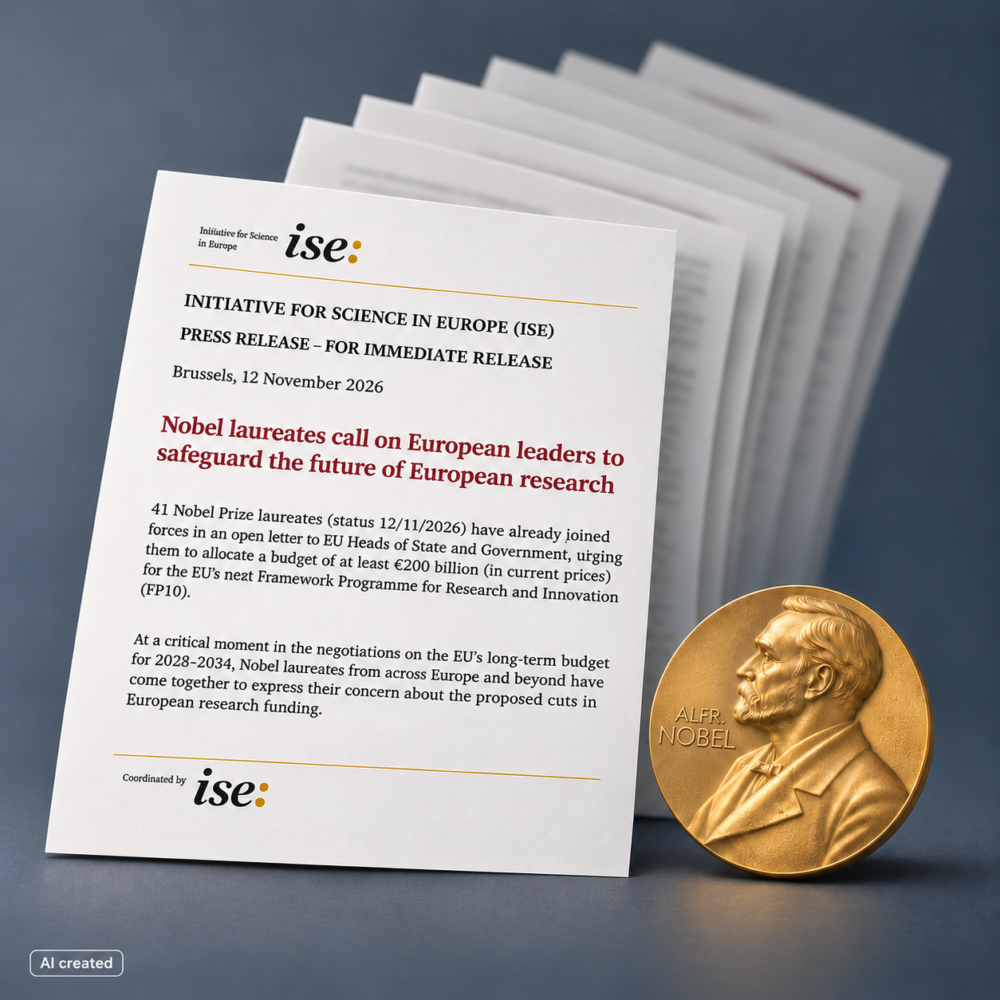
An open letter coordinated by the Initiative for Science in Europe urges EU leaders to allocate at least €200 billion to the next Framework Programme for Research and Innovation (FP10).
On 18 November 2026, the Initiative for Science in Europe (ISE) announced that 81 Nobel Prize laureates had signed an open letter addressed to the members of the European Council, calling for stronger and sustained investment in European research and innovation.
The signatories urge EU leaders to allocate at least €200 billion, in current prices, to the next EU Framework Programme for Research and Innovation (FP10), covering 2028–2034.
The appeal comes at a critical stage in negotiations over the European Union’s next Multi-annual Financial Framework (MFF), which will determine the EU’s long-term spending priorities.
Safeguarding Europe’s Scientific Future
According to the ISE press release, the European Commission initially proposed a budget of €175 billion for FP10. A revised negotiating proposal presented by the Irish Presidency of the Council on 10 October 2026 would reduce this amount to approximately €158 billion.
The Nobel laureates express concern about this potential reduction and argue that Europe’s scientific excellence, industrial competitiveness and technological future depend on sustained investment in research.
Their appeal emphasises the importance of maintaining an ambitious and independent European research programme that supports the full spectrum of scientific activity, from fundamental research to technological innovation.
The Importance of Fundamental Research
A central message of the letter is that fundamental research must remain a priority, even when its practical applications are not immediately apparent.
The signatories warn that focusing exclusively on research promising short-term returns could prevent the discoveries that eventually create entirely new scientific fields, industries and technologies.
They also highlight the role of European research funding in supporting advances in artificial intelligence, quantum technologies, biotechnology, clean energy and advanced materials.
Supporting Researchers and International Collaboration
Beyond the overall funding target, the Nobel laureates call for stronger support for the next generation of researchers.
Their recommendations include:
- Strengthening the European Research Council (ERC).
- Providing robust support for researchers through the Marie Skłodowska-Curie Actions.
- Ensuring adequate funding for collaborative fundamental and applied research across scientific disciplines.
- Supporting European-scale research infrastructure and cross-border cooperation.
The letter emphasises that scientific knowledge and innovation benefit from collaboration across national borders, making European-level research funding particularly valuable.
Nobel Laureates Unite Across Scientific Disciplines
The 81 signatories, as of 18th November 2026, represent a broad range of scientific disciplines, including physics, chemistry, medicine and economic sciences.
Among the Nobel Prize laureates in Physics supporting the appeal are Anton Zeilinger, Anne L’Huillier, Giorgio Parisi, Donna Strickland, Roger Penrose, Serge Haroche, Steven Chu and Carlo Rubbia.
Their collective appeal highlights the importance of scientific research for Europe’s long-term prosperity, technological capabilities and international competitiveness.
A Call for Long-Term Commitment
Coordinated by the Initiative for Science in Europe (ISE), the appeal asks European leaders to recognise research and innovation as long-term investments in Europe’s future.
The letter underlines that maintaining Europe’s scientific leadership requires not only ambitious objectives but also the resources needed to support researchers, institutions and collaborative scientific programmes.
As negotiations on the next EU budget continue, the Nobel laureates’ message places fundamental research, scientific cooperation and support for future generations of scientists at the centre of the discussion.
Further information
Initiative for Science in Europe (ISE): https://initiative-se.eu/
Source: Initiative for Science in Europe, press release and open letter, 13 November 2026.