

Author: Amy Walter From OA to AI, the academic world continues to evolve at a pace. At EDP Sciences, we’ve been working, as always, to keep equity and academic rigour at the heart of every advancement. Discover the latest news from EDP Sciences, an Associate Member of the European Physical Society. Research Highlights EPJ Web of Conferences Highlight – XLVI Symposium on Nuclear Physics 2025 The XLVI Symposium on Nuclear Physics (SNP) took place in Cocoyoc, Mexico from January 6-9, 2025 with an attendance of about 90 participants from 15 different countries. The SNP meeting has been organized every year since its beginning in 1978, with the exception of the COVID years, 2021 and 2022. The program consisted of 37 invited talks and a lively poster session with 38 posters over a large variety of hot topics in modern nuclear physics research: nuclear structure and reactions, radioactive beams, nuclear astrophysics, instrumentation, facilities and applications, QCD and hadronic physics, and neutrons and fundamental symmetries. Read the highlight and access the proceedings (open access) EPL article featured as a podcast on Physics World Episode: A conversation about theoretical ecology with physicists Ada Altieri and Silvia De Monte. Listen to the episode now. This episode of the Physics World Weekly podcast is a conversation with two physicists, Ada Altieri and Silvia De Monte, who are using their expertise in statistical physics to understand the behaviour of ecological communities. This discussion is based on a Perspective article that Altieri (an associate professor at the Laboratory for Matter and Complex Systems at the Université Paris Cité, France) and De Monte (a senior research scientist at the Institute of Biology in the École Normale Supérieure in Paris and the Max Planck Institute for Evolutionary Biology in Ploen, Germany) wrote for the journal EPL, which sponsors this episode of the podcast. EPJ Photovoltaics highlight: Advanced TOPCon solar cells with patterned p-type poly-Si fingers on the front side and vanishing metal induced recombination losses The Editors-in-Chief of EPJ Photovoltaics have chosen to highlight the paper ‘Advanced TOPCon solar cells with patterned p-type poly-Si fingers on the front side and vanishing metal induced recombination losses’, by Jan Hoß, Saman Sharbaf Kalaghichi, Mertcan Comak, Pirmin Preis, Jan Lossen, Jonathan Linke, Lejo Joseph Koduvelikulathu and Florian Buchholz This paper presents an interesting study and new findings on the integration of selective poly-Si fingers on the front side of TOPCon solar cells. This study could contribute to further improvement of the industrial TOPCon solar cells. The highlighted article is part of the Topical Issue on ‘EU PVSEC 2024: State of the Art and Developments in Photovoltaics’, edited by Robert Kenny and Gabriele Eder EPJB highlight: Unlocking next-gen optoelectronic with InSb/WSSe heterostructures The Editors-in-Chief of EPJB propose to highlight the paper: Study on the electronic structure and optical properties of InSb/WSSe van der Waals heterostructure, by Su, S., Zhao, X., Wang, X. et al. In this new research published in EPJ B, Weibin Zhang and colleagues at Yunnan Normal University demonstrate that heterostructures made from alternating layers of InSb and WSSe are highly suited for light absorption. If confirmed experimentally, these properties could make the material a valuable platform for harvesting light across a broad range of wavelengths—potentially paving the way for next-generation optoelectronic devices. The researchers hope their findings will provide a solid theoretical foundation for future experiments—bringing the practical use of these heterostructures one step closer. EPJ D Highlight – Improving simulations of the PIII process The paper highlighted by the Editors-in-Chief of EPJD is Numerical simulation of the PIII process considering temperature-dependent thermophysical properties in a viscous sheath, by Sattari, M., Ghasemi, J. (Eur. Phys. J. D 79, 49 (2025). Through new research published in EPJ D, Mohammadreza Sattari and Jalal Ghasemi at the University of Zanjan, Iran, present an improved approach to simulating ion dynamics within the sheath. Their results show that when variations in ion velocities driven by temperature and viscosity are included, higher currents flow perpendicular to the normal target surface. At the same time, ion kinetic energy falls by more than 20% compared with simpler models – a finding with important implications for improving PIII performance. News from EDP Sciences EDP Sciences updates its policy on AI and ethics Celebrating International Open Access Week 2025 — “Who Owns Our Knowledge?” Digital archives still valued by researchers today Journal de Physique digital archives To think that once a journal is archived, no researcher is interested in it anymore would be a misunderstanding of its continued contextual value. We were delighted to conduct research again recently and discover that many articles in the Journal de Physique archives are still being cited today. Find out more about our archives, including the most cited articles in the collection. EPJ AP digital archives The ‘European Physical Journal – Applied Physics (EPJ AP) was born in 1991, through the merging of two well-known French journals, the ‘Journal de Physique III’ and ‘Microscopy, Microanalysis, Microstructures’. It was part of a broader movement of merging publications to increase opportunities for collaboration among the European physics community and around the world. The EPJ series is globally renowned for the high-quality research it publishes, this EPJ AP archive collection forms part of the foundation on which it is built. Discover the EPJ AP digital archives Join the conversation on social media We are continually reviewing how best to support our journal communities, including how best to surface important research as it is published. We left X at the beginning of 2025 as it no longer aligned with the values we consider important in pursuit of scientific advancement, and we are now investing time in building our communities on LinkedIn, Bluesky and Instagram. If there is a platform or community where you feel our research would be beneficial but is not currently reaching, please do connect with us and let us know!
Declaration for the Future
On 14th November, the German Physical Society (DPG) and the Physical Society of Japan (JPS) signed a common “Declaration for the Future” warning on any use of nuclear weapons. In their “Declaration for the Future”, the JPS and the DPG warn that any use of nuclear weapons would have extremely serious consequences. Furthermore, they argue that nuclear armament already entails considerable risks. The societies advocate using scientific knowledge for peaceful purposes and for shaping a future worth living. In this context, they acknowledge the special responsibility of physicists.On the one hand, their research has enabled the development of nuclear weapons, but on the other hand, they have special expertise, such as that required for the control of nuclear weapons or the monitoring of disarmament efforts. Both societies invite physical societies and academic organizations worldwide to join them in this commitment. The declaration can be downloaded here, as well as from the DPG webpage where you will also find some photos of the ceremony at the Town Hall of the City of Münster: https://www.dpg-physik.de/veroeffentlichungen/aktuell/2025/gemeinsame-erklaerung-gegen-atomare-bedrohungen-unterzeichnet
The EPS SNPD Prizes 2025 are announced!
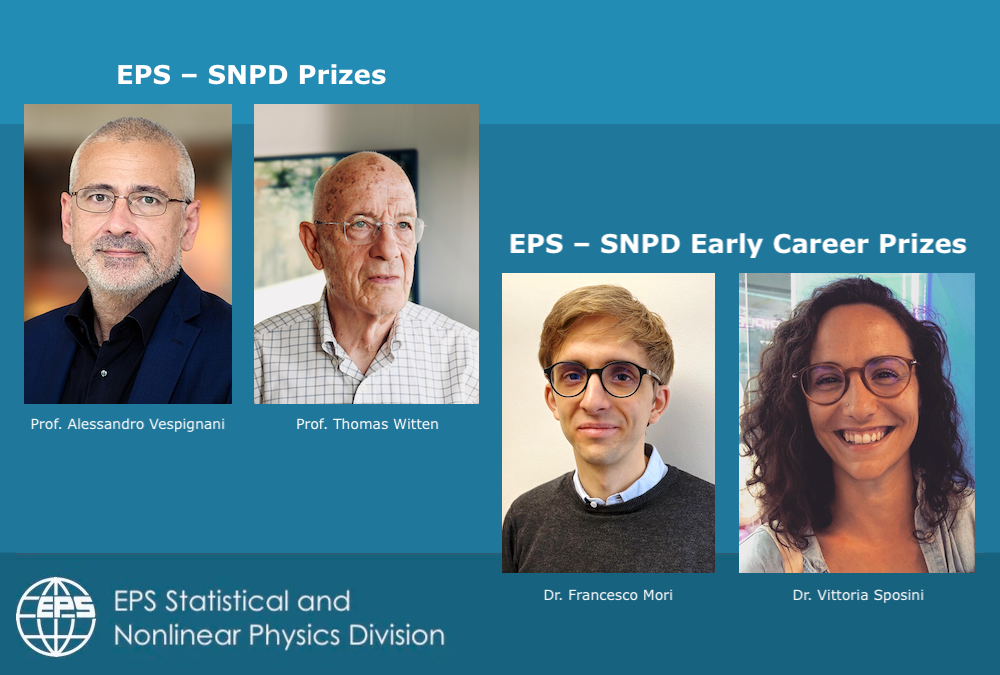
The Statistical and Nonlinear Physics Division (SNPD) of the European Physical Society (EPS) is happy to announce the winners of the EPS SNPD Prizes 2025. EPS – SNPD Prizes Professor Alessandro Vespignani – Northeastern University – USA for his seminal contributions to the statistical physics of complex networks, bridging theoretical models with real-world systems, and for unveiling the universal principles governing epidemic spreading and information diffusion. Professor Thomas Witten – University of Chicago – USA for his seminal contributions to the statistical physics of aggregation, soft matter, and complex fluids, and for unveiling principles in the dynamics of polymers, interfaces, and disordered materials. EPS – SNPD Early Career Prizes Dr. Francesco Mori – Oxford University – UK for his outstanding contributions on the statistical properties of run and tumble particles, thermodynamic cost of stochastic resetting and optimal control protocols. Dr. Vittoria Sposini – Università di Padova – Italy for her outstanding contribution to the statistical physics of anomalous diffusion, stochastic processes and random diffusivity.
Heinrich Hertz Lecture Hall at KIT named as an EPS Historic Site
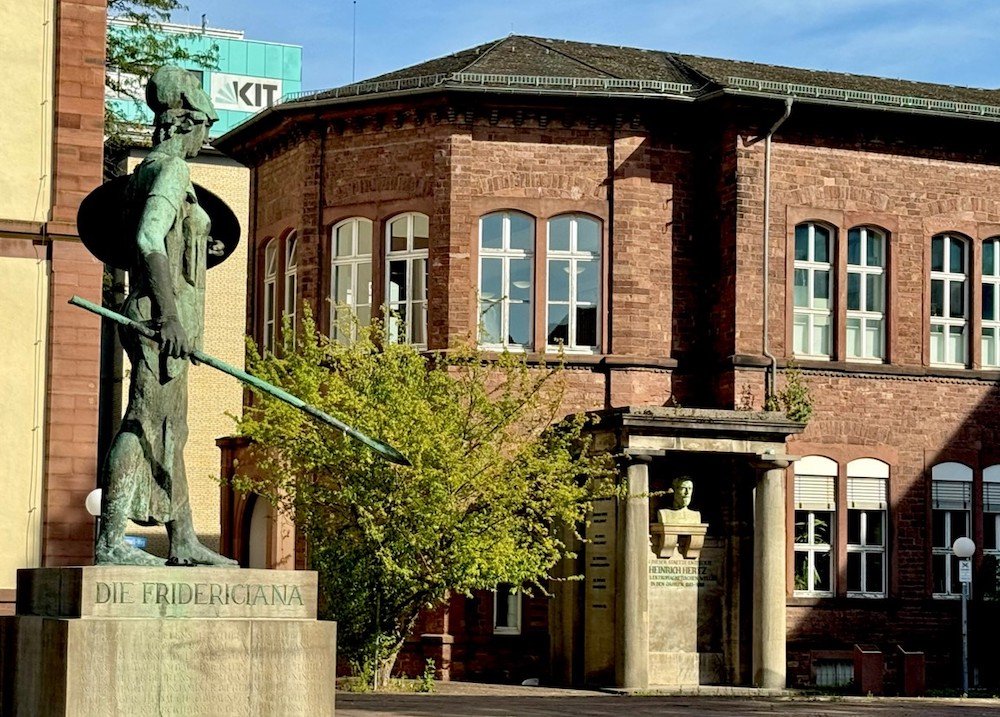
Authors: Guido Drexlin and Thomas Muller On October 30 2025, the European Physical Society (EPS) conferred the award `EPS Historic Site´ on the Heinrich Hertz Lecture Hall at the Karlsruhe Institute of Technology (KIT) in recognition of the series of ingenious experiments carried out at this site in 1886 by Heinrich Hertz. This newest EPS Historic Site, still being in regular use today for lectures at KIT, formed the ideal surroundings for a highly instructive view on the foundational research by Hertz. It also allowed putting the excellence of the physical sciences in Karlsruhe on a map in Europe and beyond. The first observation of electromagnetic waves by Heinrich Hertz, sent and received by antennae, successfully tested the laws of electromagnetism as described by Maxwell´s equations. Beyond that, it marks a seminal event in the history of physics and engineering that has paved the ground for the development of technologies that have been transformative for modern societies. Heinrich Hertz held a position as Professor of physics from 1885 to 1889 at the Technical University of Karlsruhe, a predecessor institution of KIT. His experiments were carried out at today’s Heinrich Hertz Lecture Hall, in close proximity to a Memorial dedicated to his legacy. On the 100th anniversary of the unveiling of that memorial on October 30, 1925 a special EPS Colloquium honoured the achievement of Hertz with a series of talks. The convenors of the fully packed symposium, Guido Drexlin and Thomas Müller from KIT, put together a series of talks and key notes, reviewing the fundamental relevance of Heinrich Hertz then and now, including a lively experimental demonstration of his breakthrough experiment. The highlight of the Colloquium was marked by the unveiling of the commemorative plaque by several attendees, including the Presidents of the EPS, Professor Mairi Sakellariadou, and of the DPG, Professor Klaus Richter, as well as KIT´s Vice President Academic Affairs, Professor Oliver Kraft. The latter emphasised that `The discovery of electromagnetic waves by Heinrich Hertz has been fundamental for wireless communication. Many of today´s technologies such as television, mobile phone communication, or WLAN would not be conceivable without this discovery. KIT takes pride in receiving the EPS Historic Site Award today´. Following the festive ceremony, the commemorative plaque will be placed in due time at the Ehrenhof of KIT next to the memorial of Heinrich Hertz as an inspiration for future generations of scientists. Image credit: KIT
LHC Collaborations at CERN Win the 2025 Breakthrough Prize in Fundamental Physics
Author: Anna Di Ciaccio The four major international collaborations at CERN’s Large Hadron Collider — ATLAS, CMS, ALICE and LHCb — have been jointly awarded the 2025 Breakthrough Prize in Fundamental Physics, in recognition of their outstanding contributions to advancing our understanding of the fundamental laws of nature. The prize honours the achievements of thousands of scientists, engineers and technicians from more than 70 countries, whose collective work during the LHC’s second data-taking run has delivered groundbreaking results in particle physics. Their research has deepened knowledge of the Higgs boson, explored the quark–gluon plasma, and revealed new insights into matter–antimatter asymmetries and the structure of hadrons. The ATLAS and CMS collaborations were recognized for precision studies of the Higgs boson and its role in the mechanism that gives mass to fundamental particles. ALICE was honoured for its investigations of the primordial state of matter that existed shortly after the Big Bang, while LHCb was celebrated for its discoveries in flavour physics and for testing fundamental symmetries. The $3 million prize will be donated in full to the CERN & Society Foundation, which will allocate the funds to support doctoral fellowships and training opportunities for young researchers at CERN, helping to inspire and equip the next generation of scientists. The Breakthrough Prize, established in 2012, is among the most prestigious distinctions in science, celebrating major achievements in fundamental research. This year’s award acknowledges both the scientific excellence and the global spirit of cooperation that define CERN’s mission. The Breakthrough Prize winners are selected by selection committees made up of previous laureates. The cash for the prize is provided by personal foundations founded by Sergey Brin & Anne Wojcicki, Mark Zuckerberg & Priscilla Chan, and Yuri & Julia Milner, among others. This recognition also resonates within the European Physical Society (EPS) community. Three members of the EPS Executive Committee — Anna Di Ciaccio (ATLAS), Alessandra Fantoni (ALICE) and Ulrich Husemann (CMS) — are active participants in the LHC collaborations. Their involvement underlines the strong connection between CERN’s pioneering research and the broader European physics community represented by the EPS, united by a shared commitment to collaboration, excellence, and the advancement of science. LHC is in the middle of Run 3 and prepares for the High-Luminosity LHC (HL-LHC) phase, the collaborations continue to push the boundaries of precision and discovery, paving the way for new insights into the nature of the universe. More about the 2025 Breakthrough Prize in Fundamental Physics: https://breakthroughprize.org/Laureates/1
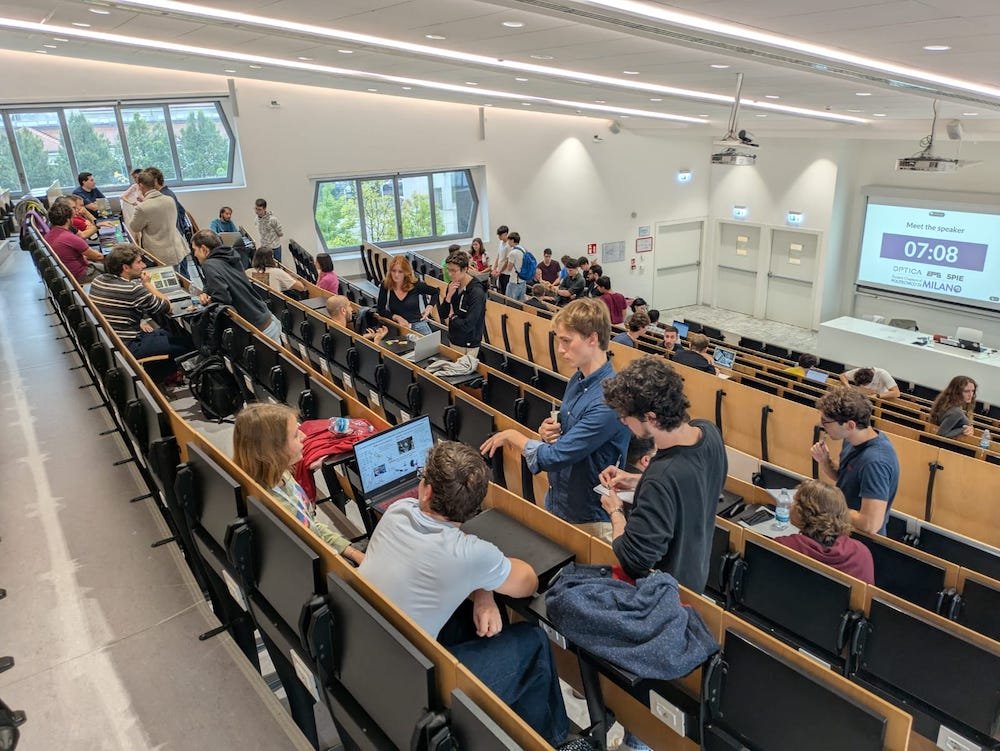
EPS Young Minds: Speed Date With Research 7.0
Author: Francesco Di Pasquale – Milan PYMP On September 27th, the Politecnico di Milano hosted the seventh edition of Speed Date with Research, a workshop that aims to connect students with the research environment. In its seventh edition, the workshop gave students a chance to learn about numerous research opportunities and hear about potential thesis projects. Speed Date with Research is a yearly event of the Student Chapter of Politecnico di Milano, in collaboration with the Physics Department. The event is designed to give students a better idea of the research being conducted in the department and the kind of thesis projects offered. The approach is simple but effective: the students have short, timed meetings with researchers, in which they can hear about different research areas and ask questions about potential thesis projects. This year’s session, Speed Date with Research 7.0 was a great success, allowing students to interact directly with researchers and feel the work going on in the Department of Physics. It included 80 master students of the Engineering Physics course of study, who were all eager to get more information about research in their field. They were able to interact with 41 researchers, one from each of the Department of Physics laboratories. The session was held in eight 10-12 minute sessions, with students rotated through the different researchers. Each session had one of the researchers give a quick pitch of their research and thesis topics available, and then students could ask questions in order to learn more. One of the major aims of the event was to spark the curiosity of the students. Through the experience of researchers and information about their work, students were encouraged to find out something that indeed interested them. The intention was to convey to them the driving force behind research itself, the passion of discovery and the motivation to pursue new ideas. The hope was that each student would have a clearer sense of direction for their course of academic pursuit when they left the event and perhaps a new spark of interest to carry them on. In short, Speed Date with Research 7.0 provided the Politecnico di Milano physics students with an enriching experience. It provided them with a chance to learn more about the research undertaken in the Department of Physics and possible thesis subjects in a personal and interactive way.
Physics is driving Europe’s economy
The European Physical Society released a new Cebr report about “The Importance of Physics for the Economies of Europe” Brussels, 4th November 2025 The European Physical Society (EPS) and the Centre for Economic and Business Research (Cebr) have released the third edition of the report “The Importance of Physics to the Economies of Europe”. An update to the previous version released in 2019, this report covers the years 2016-2022 and details the impact of physics-based businesses on the economy of the EU member states, three EFTA countries and the UK. The report demonstrates that physics is not only a scientific field—it is a strategic driver of growth, productivity, and resilience. The report shows that physics-based industries had €7.07 trillion in turnover in 2022 and contributed €2.30 trillion in Gross Value Added (GVA) in 2022. Physics based industries are resilient with a strong post-pandemic recovery in business creation, employment and output. Whilst Germany as the EU’s largest economy dominates in absolute terms, physics-based industries make up significant proportions of the economies of other European countries, for example more than one in six Swiss workers and over 15% of workers in the Czech Republic, Slovenia and Slovakia were employed around physics-related activities in 2022. Physics based industries directly support 20.1 million jobs, and productivity of workers in these industries is 68% higher than the European average. The report highlights that the physics-based sector has increased its investment in research and development (R&D) activities by 36.5% since 2016 excluding internal investments in R&D activities which cannot be quantified. Prof. Mairi Sakellariadou, the EPS President says “the report demonstrates that investment in physics research and education translates into quantifiable benefits to the European economy. The highly skilled workforce in this sector is extremely productive, and we should support future generations to work in these industries” Owen Good, Director and Head of Economic Advisory at Cebr said “Our findings demonstrate the continued economic value that the physics community bring to the European economy. Since we last conducted similar analysis in 2018, we have found a significantly increased economic contribution, with the physics-based sector employing over 20 million people and directly contributing over €2.3 trillion to the European economy in 2022. Underpinning this contribution is a strong post-COVID recovery, with the sector rebounding well to pre-pandemic levels of economic activity.” About the EPS The European Physical Society (EPS) is a not-for-profit association whose members include 42 National Physical Societies in Europe, individuals from all fields of physics, and European research institutions and physics-based companies. As a learned society, the EPS engages in activities that strengthen ties between physicists in Europe. As a federation of National Physical Societies, the EPS advocates for issues of common interest to all European countries relating to physics research, science policy and education. Go to www.eps.org EPS Contact: anne.pawsey@eps.org About Cebr Cebr is an independent London-based economics consultancy providing economic impact assessment, forecasting and policy analysis for public and private sector clients www.cebr.com
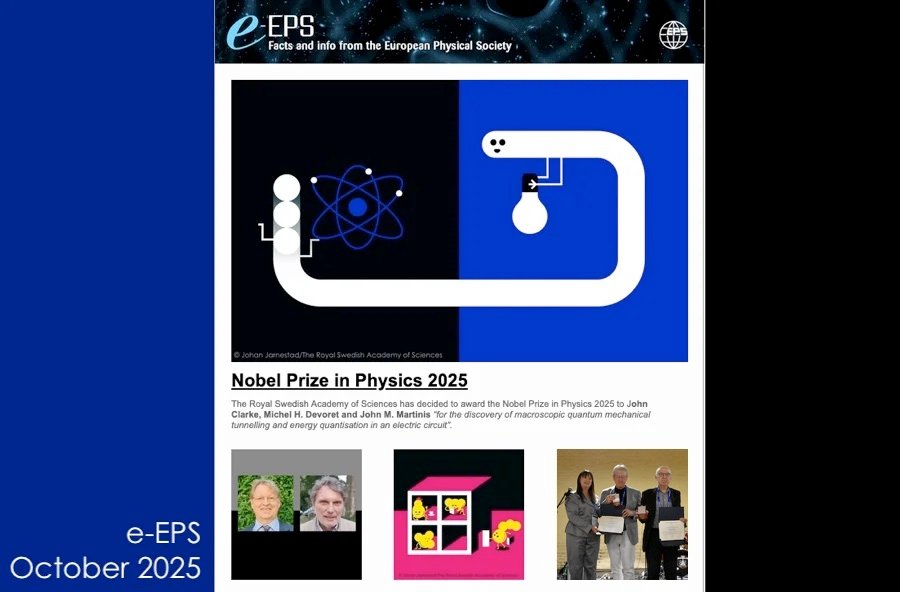
The October issue of e-EPS is out!
Read the October 2025 issue of e-EPS here. e-EPS is the Society’s monthly newsletter.
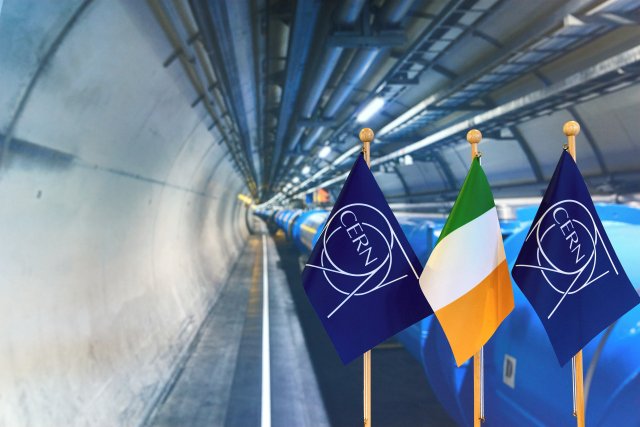
Ireland becomes an Associate Member State of CERN
CERN welcomes Ireland as an Associate Member State Ireland has officially become an Associate Member State of CERN, following confirmation that it has taken all the necessary steps to ratify the Associate Membership Agreement and accede to the protocol on CERN’s privileges and immunities. The starting date of Ireland’s status as an Associate Member State is 22 October 2025. The ratification of the agreement, which was signed in May 2025 by the CERN Director-General, Fabiola Gianotti, and James Lawless, Ireland’s Minister for Further and Higher Education, Research, Innovation and Science, marks the beginning of a new chapter in CERN’s relations with Ireland and opens up new opportunities. CERN’s collaboration with institutes from Ireland has a long history, dating back to the 1960s, when Ireland participated in bubble-chamber experiments at CERN. Since then, the country’s scientific community at CERN has made important contributions across a wide range of fields, including experimental physics, theory, medical applications and computer science. Major CERN experiments and facilities, such as ATLAS, CMS, LHCb and ISOLDE, have all benefited from Ireland’s involvement, and Associate Membership will ensure that the country’s contributions can continue and expand in the years to come. Irish representatives will now participate in meetings of the CERN Council and its committees, including the Finance Committee and the Scientific Policy Committee. Nationals of Ireland are eligible to apply for limited-duration staff positions and to CERN’s graduate programmes, and Irish firms can bid for CERN contracts, increasing opportunities for industrial collaboration on advanced technologies.
“Rival” neutrino experiments NOvA and T2K publish first joint analysis
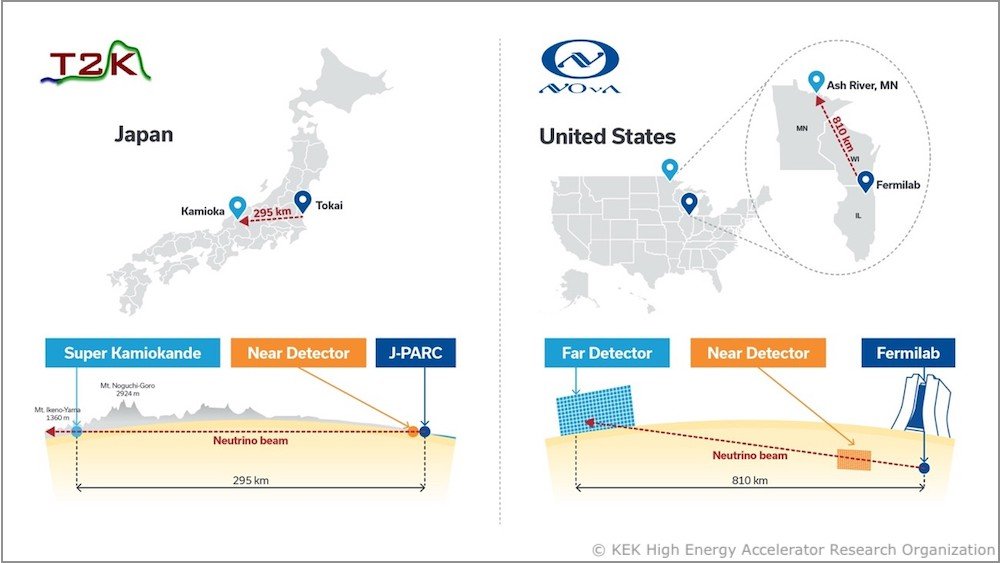
The combined results add to physicists’ understanding and they validate the impressive collaborative effort between two competing – yet complementary – experiments PRESS RELEASE OF THE T2K AND NOvA COLLABORATIONS When the universe began, physicists expect there should have been equal amounts of matter and antimatter. But if that were so, the matter and antimatter should have perfectly canceled each other out, resulting in total annihilation. And yet, here we are. Somehow, matter won out over antimatter — but we still don’t know how or why. Physicists suspect the answer may lie in the mysterious behavior of abundant yet elusive particles called neutrinos. Specifically, learning more about a phenomenon called neutrino oscillation — in which neutrinos change types, or flavors, as they travel — could bring us closer to an answer. The international collaborations representing two neutrino experiments, T2K in Japan and NOvA in the United States of America, recently combined forces to produce their first joint results, published today in the journal Nature. This initial joint analysis provides some of the most precise neutrino-oscillation measurements in the field. Johannes Gutenberg University Mainz (JGU) is represented in these collaborations by the members of the local T2K group, which is led by Professor Alfons Weber and Dr. Lukas Koch from the Experimental Particle and Astroparticle Physics group at the Institute of Physics. “I have been involved in both these fantastic experiments. It is great to see the two collaborations working closely together to achieve a result that we could not have done individually. We now have a more robust understanding of the nature of neutrinos, and I am looking forward to seeing what we can achieve in the future,”says Weber, who is also member of the cluster of excellence PRISMA+. “To me, the most exciting part of this joint result is the methodology that we developed to make it possible,” adds Koch. “It is far from trivial to combine the data of two experiments with different analysis methods, uncertainty models, and software frameworks. This great work will be the foundation for future combined results, not just from T2K and NOvA, but also from the next generation of neutrino beam experiments: Hyper-Kamiokande and DUNE.” Different experiments, common goals Despite their ubiquity, neutrinos are very difficult to detect and study. Even though they were first seen in the 1950s, the ghostly particles remain deeply enigmatic. Filling in gaps in our knowledge about neutrinos and their properties may reveal fundamental truths about the universe. T2K and NOvA are both long-baseline experiments: they each shoot an intense beam of neutrinos that passes through both a near detector close to the neutrino source and a far detector hundreds of miles away. Both experiments compare data recorded in each detector to learn about neutrinos’ behavior and properties. NOvA, the NuMI Off-axis νe Appearance experiment, sends a beam of neutrinos 810 kilometers from its source at the U.S. Department of Energy’s Fermi National Accelerator Laboratory near Chicago, Ill., to a 14,000-ton liquid-scintillator detector in Ash River, Minnesota. The T2K experiment’s neutrino beam travels 295 kilometers from Tokai to Kamioka — hence the name T2K. Tokai is home to the Japan Proton Accelerator Research Complex (J-PARC) and Kamioka hosts the Super-Kamiokande neutrino detector, an enormous tank of ultrapure water located a kilometer underground. Since the experiments have similar science goals but different baselines and different neutrino energies, physicists can learn more by combining their data. “By making a joint analysis you can get a more precise measurement than each experiment can produce alone,” says NOvA collaborator Liudmila Kolupaeva. “As a rule, experiments in high-energy physics have different designs even if they have the same science goal. Joint analyses allow us to use complementary features of these designs. “ As long-baseline experiments, NOvA and T2K are ideal for studying neutrino oscillations, a phenomenon that can provide insight into open questions like charge-parity violation and the neutrino mass ordering. Two experiments with different baselines and energies have a better chance of disentangling the two effects than one experiment alone. Interrogating neutrino oscillations The mystery of neutrino mass ordering is the question of which neutrino is the lightest. But it isn’t as simple as placing particles on a scale. Neutrinos have miniscule masses that are made up of combinations of mass states. There are three neutrino mass states, but, confusingly, they don’t map to the three neutrino flavors. In fact, each flavor is made of a mix of the three mass states, and each mass state has a different probability of acting like each flavor of neutrino. There are two possible mass orderings, called normal or inverted. Under the normal ordering, two of the mass states are relatively light and one is heavy, while the inverted ordering has two heavier mass states and one light. In the normal ordering, there is an enhanced probability that muon neutrinos will oscillate to electron neutrinos but a lower probability that muon antineutrinos will oscillate to electron antineutrinos. In the inverted ordering, the opposite happens. However, an asymmetry in the neutrinos’ and antineutrinos’ oscillations could also be explained if neutrinos violate CP symmetry — in other words, if neutrinos don’t behave the same as their antimatter counterparts. The combined results of NOvA and T2K do not favor either mass ordering. If the neutrino mass ordering is found to be normal, NOvA’s and T2K’s results are less clear on CP symmetry, requiring additional data to clarify. However, if future results show the neutrino mass ordering is inverted, the results published today provide evidence that neutrinos violate CP symmetry, potentially explaining why the universe is dominated by matter instead of antimatter. “Neutrino physics is a strange field. It is very challenging to isolate effects,” says Professor Kendall Mahn, co-spokesperson for T2K. “Combining analyses allows us to isolate one of these effects, and that’s progress.” The combined analysis does provide one of the most precise values of the difference in mass between neutrino mass states. With an uncertainty below 2%, the new value will enable physicists to make