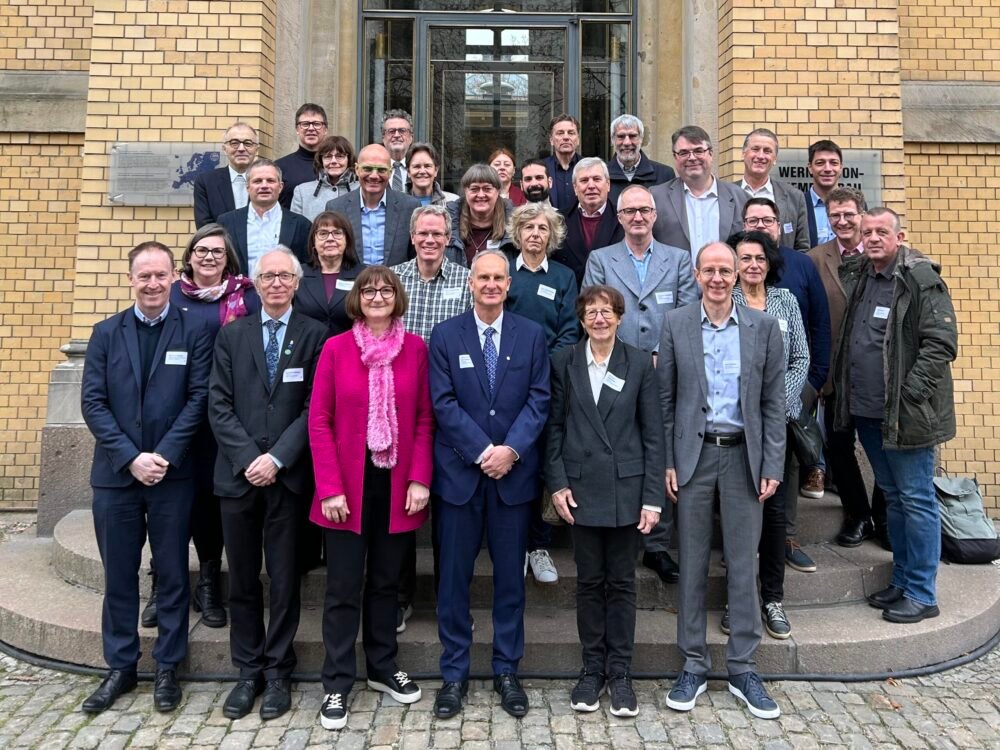
A Declaration of the Presidents of Physical Societies in Europe
Berlin, November 2026
From the very beginning, physicists shaped Neural Networks and the field of Artificial Intelligence (AI). Physicists are experts in the development and adaptation of AI systems, as demonstrated by the award of the 2024 Nobel Prize in Physics to two AI pioneers. Now, AI affects research in physics, physics education, and careers in physics, and the ultimate extent of its impact is unforeseeable. It is currently difficult to assess what the emergence of ever-improving AI systems will mean for physics and a wider society
We feel a particular responsibility, as physicists, to contribute to the development of principles governing the use of AI in physics and beyond. The European Physical Society and its member societies therefore intend to set up a working group to develop approaches for exploring the opportunities and challenges presented by AI.
In addition to numerous unresolved legal and practical issues, the following fundamental questions seem particularly significant from the perspective of physics:
Regarding teaching physics and the job market for physicists:
- What content should be taught in physics degree programmes in the future, and what skills should be imparted?
- What skills will set physicists apart in the labour market of the future?
- How can AI be used to improve teaching and learning?
- How can students be taught to use AI ethically and competently?
- What are the consequences of the increasing use of AI for students’ social skills and mental health?
- What impact will AI have on the staffing structure in higher education establishments?
Regarding physics research and its applications:
- What will distinguish a good physics researcher from someone who ‘merely’ applies AI effectively to research questions without understanding the underlying physics?
- Which research tasks might be performed and even improved by AI and which tasks is it less likely to handle? What might this mean for the staffing structure of research institutions and for their funding?
- What are the opportunities offered by AI, to advance physics research?
- Agentic AI can already propose and carry out its own research agenda, although the scope is still limited. What level of human supervision and regulation is required?
- What does the widespread use of AI in research mean for scientific publishing, for the acquisition of scientific reputation and for the allocation of research funding?
- How can we ensure that research results developed using AI are used responsibly and ethically?
These lists are by no means exhaustive, but they do give an idea of the scale of the outstanding issues. As the presidents of physical societies throughout Europe, we therefore welcome the fact that the European Physical Society intends to apply its collective expertise to the topic.
This declaration is endorsed by:
Prof. Alberta Bonanni
prof. dr. sc. Vernesa Smolčić
Demetrios Philippou
Dr Wim J. van der Zande
Prof. Jose Maria De Teresa
Prof. Juha Muhonen
Dr. Heike Riel
Paul Howarth
Angela Bracco
Dr. Norbert Marxer
Academician Dr. Habil. Grazina Tautvaisiene
Prof. Stanislaw Kistryn
Bratislav Obradović
prof. RNDr. Jozef Kúdelčík, PhD.
prof. dr. Anton Ramšak
Prof. Lambe Barandovski
Prof. Dr. Luis Viña
Prof. Dr. Michel Calame
Baki Akkuş
President of the Austrian Physical Society
President of the Croatian Physical Society
President of the Cyprus Physicists Society
President of the Dutch Physical Society
President of the European Physical Society
President of the Finnish Physical Society
President of the German Physical Society (DPG)
President of the Institute of Physics (UK & Ireland)
President of the Italian Physical Society (SIF)
President of the Liechtenstein Physical Society
President of the Lithuanian Physical Society
President of the Polish Physical Society
President of the Serbian Physical Society
President of the Slovak Physical Society
President of the Society of Mathematicians, Physicists, and Astronomers of Slovenia
President of the Society of Physicists of Macedonia
President of the Spanish Royal Physics Society
President of the Swiss Physical Society
President of the Turkish Physical Society