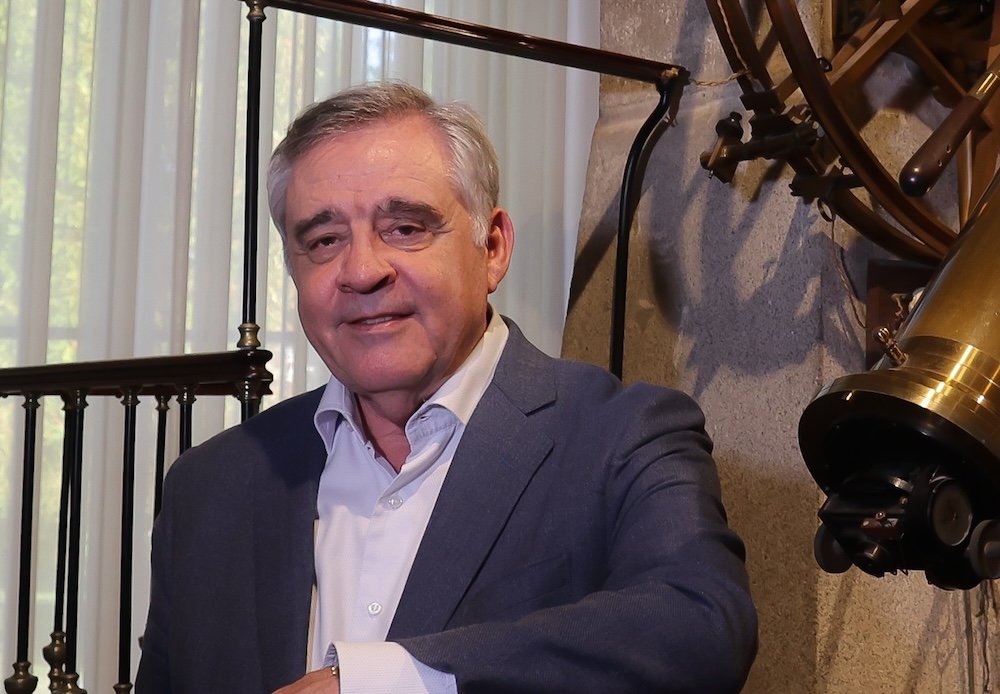
Rafael Bachiller is an astronomer and Director of the Spanish National Astronomical Observatory and the Royal Observatory of Madrid, both part of the National Geographic Institute of Spain (IGN). His research focuses on star formation, planetary nebulae and the interstellar medium. He has also gained international recognition through his contributions to the study of star formation and planetary nebulae.
He currently chairs the Scientific Committee of the Spanish Eclipse Trio (2026–2028), coordinating the scientific research and public outreach activities associated with this exceptional sequence of two total and one annular solar eclipses visible from Spain. He was interviewed at the occasion of the first of the series.
- On 12th August 2026, Spain witnessed a total solar eclipse. Could you explain the phenomenon and why it was visible as a total eclipse in some places but only as a partial eclipse elsewhere?
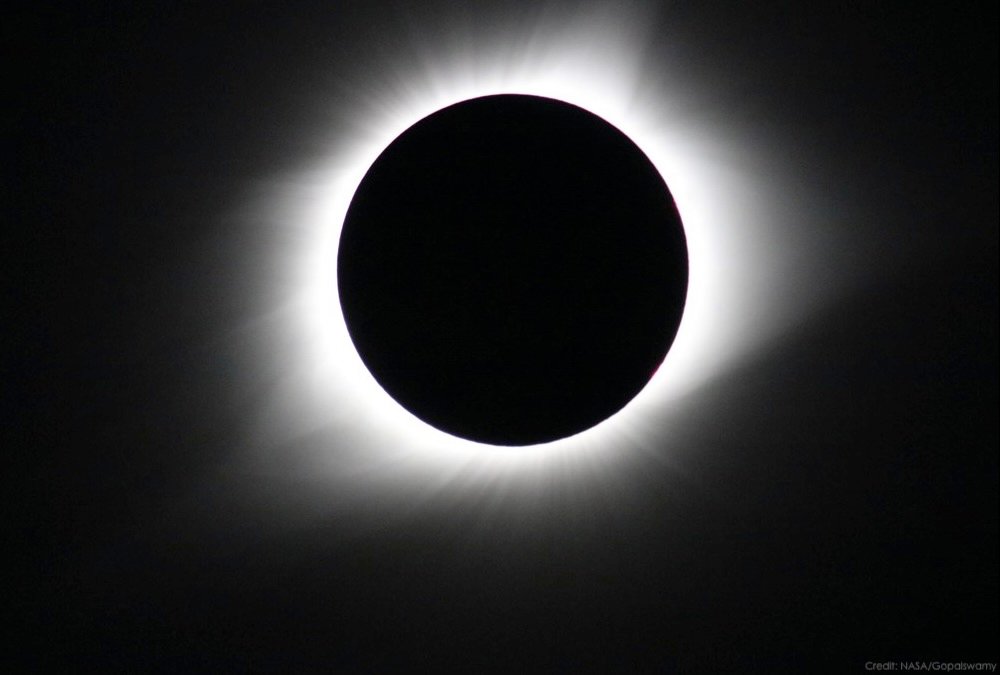
A solar eclipse occurs when the Moon passes precisely between the Earth and the Sun. Although the Moon is about 400 times smaller in diameter than the Sun, it is also approximately 400 times closer to us, so both bodies appear to have nearly the same angular size in the sky. This remarkable coincidence allows the Moon to completely obscure the solar photosphere during a total eclipse.
However, the Moon’s umbral shadow is only a few hundred kilometres wide when it reaches the Earth’s surface. Observers located inside this narrow corridor experience totality, while those outside remain within the penumbra and see only a partial eclipse. The difference is far greater than the terminology might suggest: during totality the sky darkens dramatically, the brightest planets and stars become visible, the temperature drops, and the solar corona suddenly emerges. None of these phenomena can be experienced during even a very deep partial eclipse.
The eclipse of 12 August 2026 is exceptional for several reasons. It is the first of an extraordinary sequence of two total and one annular eclipse crossing Spain between 2026 and 2028. It will be the first total solar eclipses visible from mainland Spain for more than a century. Moreover, it occurs close to sunset, offering unique opportunities to observe the eclipsed Sun against historical landscapes while posing interesting observational challenges.
- When were eclipses first understood scientifically?
Eclipses have been recorded for more than three thousand years, with the earliest written accounts coming from Mesopotamia and ancient China. For much of human history they were interpreted as supernatural events or divine omens capable of influencing the fate of kingdoms.
One of the earliest scientific explanations was proposed by Anaxagoras in the fifth century BC, who recognised that eclipses result from the relative motions of the Sun, Earth and Moon. This represented a major intellectual milestone: eclipses became one of the first celestial phenomena to be understood in purely natural terms rather than through mythology.
Babylonian astronomers later discovered the approximately 18-year Saros cycle, allowing remarkably successful empirical predictions without a complete physical explanation, although they could not predict where on Earth totality would be visible.
The real revolution came with Newton’s Philosophiæ Naturalis Principia Mathematica in 1687. Universal gravitation transformed eclipses into fully predictable consequences of celestial mechanics. Since then, increasingly accurate orbital theories have allowed eclipse predictions with remarkable precision, making them one of the most impressive demonstrations of the predictive power of classical physics.
- The eclipse attracted professional astronomers, amateurs and the general public alike. What scientific value do these observations still provide today?
Total solar eclipses remain unique natural laboratories for investigating the coupled Sun-Earth system. Although modern coronagraphs can artificially occult the solar disc, thereby reproducing many of the observing conditions of a total eclipse, natural eclipses still provide one of the very best opportunities to investigate the innermost solar corona, where many fundamental questions concerning coronal heating, magnetic field topology and the origin of the solar wind remain open.
At the same time, eclipses provide ideal conditions for studying the response of the Earth’s atmosphere and ionosphere to the abrupt reduction in solar irradiance. During the first Spanish eclipse on 12 August 2026, several coordinated campaigns monitored atmospheric dynamics, ionospheric disturbances and thermal variations, while high-altitude balloon experiments observed the passage of the lunar shadow from the stratosphere.
The contribution of amateur astronomers to such projects is highly valuable. Their observations greatly increase geographical coverage and temporal sampling, while modern digital instrumentation often allows data of remarkable scientific quality. In this respect, total eclipses illustrate particularly well how professional research and citizen science can complement each other.
Beyond the scientific return, eclipses represent an extraordinary opportunity to engage society with physics and astronomy. Very few natural phenomena succeed in bringing together researchers, educators and millions of citizens around the same scientific event.
- You have played a leading role in coordinating the Spanish Eclipse Trio. Are you also involved in international scientific or outreach initiatives?
As Director of the Spanish National Astronomical Observatory and Chair of the Scientific Committee for the Spanish Eclipse Trio (2026–2028), one of my main responsibilities has been coordinating scientific activities, public outreach and collaboration among the many institutions involved in these exceptional events.
The National Astronomical Observatory is Spain’s oldest astronomical institution (it is currently part of the National Geographic Institute). From this institution, major scientific expeditions were organised to observe the total solar eclipses visible from Spain in 1860, 1870, 1900, 1905, 1912 and 1959. In this sense, my current involvement in the Eclipse Trio is a natural continuation of one of the Observatory’s oldest scientific traditions. This continuity over more than 160 years illustrates how scientific institutions preserve knowledge across generations while constantly adapting to new scientific questions and technologies.
The scale of the Eclipse Trio also prompted the Spanish Government to establish an Interministerial Committee, operating at a governmental level alongside the Scientific Committee, highlighting how a major astronomical event can extend well beyond science to involve education, civil protection, tourism and public engagement.
Large eclipses naturally transcend national boundaries. They encourage cooperation between solar physicists, atmospheric scientists, geodesists, observatories, universities, public administrations and amateur organisations. Throughout my scientific career I have also participated in numerous international collaborations, both in astrophysical research and in science communication, because astronomy has always been an intrinsically international discipline.
One of the principal objectives of the Scientific Committee has been to ensure that these eclipses leave a lasting legacy. Beyond the scientific observations themselves, we hope they will strengthen scientific culture, promote dark-sky protection and encourage sustainable astrotourism throughout southern Europe.
- When did your own interest in astronomy begin?
My interest began during childhood, under the dark skies of rural Spain. The Milky Way was a familiar presence on clear summer nights, and I soon found myself wondering what all those stars actually were. As with many astronomers, my first motivation was curiosity rather than any clear professional ambition.
Later on, what fascinated me most was the extraordinary ability of physics to explain such beautiful and apparently mysterious phenomena with astonishing precision. Astronomy combines observation, mathematics and fundamental physics in a uniquely elegant way, and that combination has fascinated me ever since.
Even today, after decades of research, I still experience the same sense of wonder whenever I observe a truly dark sky or witness a total solar eclipse. I believe that scientific understanding does not diminish that emotion. Quite the opposite–it enriches it.
- What is your current research field and what are its main challenges?
Although a significant part of my present activity is devoted to scientific leadership and the coordination of large national initiatives such as the Eclipse Trio, my research has always focused on the physics of the interstellar medium, star formation and astrochemistry.
I am particularly interested in understanding how diffuse interstellar gas condenses into molecular clouds, how stars form within those clouds, and how stellar feedback subsequently regulates the evolution of galaxies. These processes involve a complex interplay between gravity, turbulence, magnetic fields, radiation and astrochemistry across an enormous range of spatial scales.
We are currently living through an exceptionally exciting period, and in Spain we are well placed for research in astronomy, in particular for the study of star and planet formation. Facilities such as the Yebes 40-m radio telescope, the IRAM 30-m radio telescope, the NOEMA and ALMA interferometer arrays, and JWST are providing observations of unprecedented quality. The challenge is now to integrate multi-wavelength observations with increasingly sophisticated theoretical models and numerical simulations in order to develop a coherent physical picture of star and planet formation and, ultimately, galaxy evolution.
- What would you say to young people who are considering a career in physics or astronomy?
First of all, I would encourage them to follow their curiosity. Physics is not simply a body of knowledge; it is a way of thinking. It teaches us how to observe, formulate questions, test hypotheses, analyse evidence and distinguish reliable knowledge from speculation.
In my opinion, astronomy is particularly rewarding because it addresses some of humanity’s oldest and deepest questions, while at the same time driving technological innovation in instrumentation, computation and data analysis. I do believe that it has become one of the most interdisciplinary branches of modern science.
My advice would be not to be discouraged by the difficulty of the subject, although a solid background in mathematics is certainly an advantage. Every scientist encounters moments when progress seems slow or problems appear intractable. From my experience, curiosity and perseverance are ultimately far more important than brilliance. Scientific research is a continuous process of learning, and one of its greatest rewards is realising that, much like the Universe itself, the frontier of knowledge is constantly expanding. Every answer inevitably gives rise to new -and often even more fascinating- questions.