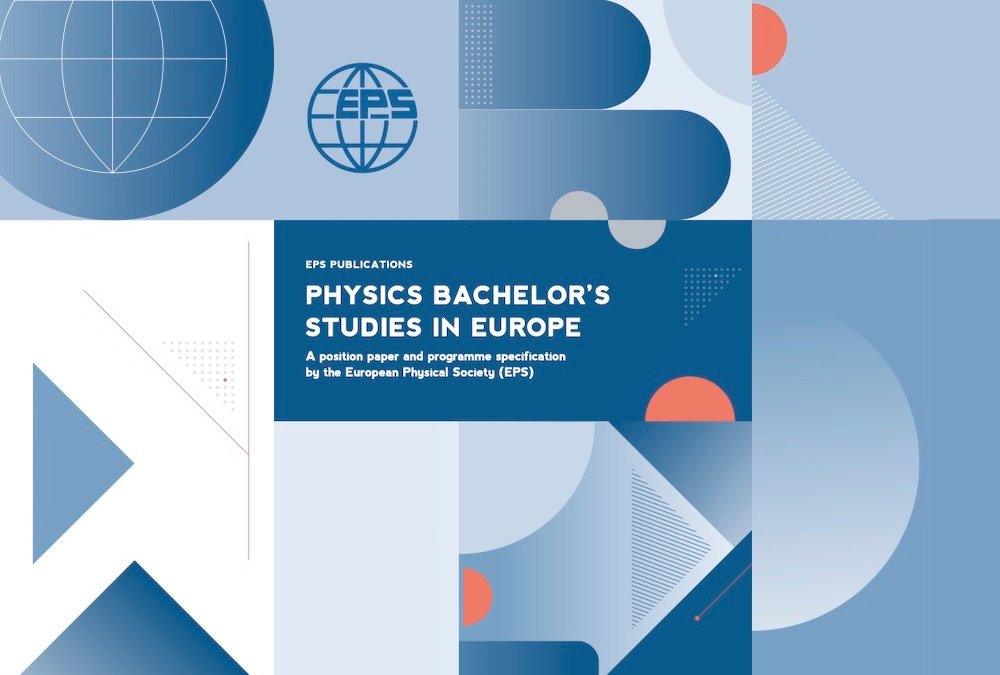
The European Physical Society is proud to announce the launch of its new position paper on Physics Bachelor’s Studies in Europe, providing an updated European perspective on the knowledge, skills and competences that physics graduates should acquire and on how bachelor’s programmes can respond to a rapidly changing educational and professional landscape.
The new position paper substantially updates the first edition, published in 2009, which was developed primarily in the context of the Bologna Process and the harmonisation of European higher education.
The 2026 edition addresses significant global opportunties and challenges that have emerged in recent years to consider the influence of sustainable development, interdisciplinarity, data science, digital technologies, and artificial intelligence, as well as changing workplaces and employer expectations on physics education.
Particular attention is given to the transitions students make—from secondary school to university, from bachelor’s to postgraduate study, and from university into employment—as well as to international mobility. The paper also highlights the importance of combining strong disciplinary foundations in physics with generic competences such as problem solving, communication and scientific integrity, and of preparing graduates for increasingly data-rich and interdisciplinary professional environments.
Drawing on current research in physics education, the paper brings together recommendations, examples of good practice and evidence-based approaches to teaching, learning, assessment and programme development. Recognising the diversity of higher-education systems and physics programmes across Europe, these recommendations are not intended as a prescriptive curriculum or checklist. Rather, institutions are encouraged to select and adapt approaches that best fit their own objectives, programmes and local circumstances.
Prof. Mairi Sakellariadou, EPS vice-president and the project’s initiator, says “I am delighted that the EPS has produced a document that reflects the rapidly changing professional environment our students are entering, including the growing importance of technological and transferable skills in the era of artificial intelligence and increasing international mobility. I hope that its recommendations will help inform and inspire the continuing development of physics education across Europe.”
Prof. Andreas Müller, the lead author of the position paper, says “I greatly appreciate the strong voice that the EPS provides for physics and physics education. This position paper helps ensure that physics takes its proper place in a rapidly changing world and that our degree programmes continue to prepare students both for the advancement of the discipline and for the increasingly diverse roles physicists play in society.”
About the EPS
The European Physical Society (EPS) is a not for profit association whose members include 42 National Physical Societies in Europe, individuals from all fields of physics, and European research institutions.
As a learned society, the EPS engages in activities that strengthen ties among the physicists in Europe. As a federation of National Physical Societies, the EPS studies issues of concern to all European countries relating to physics research, science policy and education.
About the Physics Bachelor’s Studies Working Group.
The group consists of
Andreas Müller (University of Geneva Switzerland, andreas.mueller@unige.ch)
Eilish McLoughlin (Dublin City University, Ireland)
Anne Pawsey (European Physical Society, France)
Carlos Damián Rodríguez-Fernández (University of A Coruña, Spain)
Stefan Roth (RWTH Aachen University, Germany)
Petra Rudolf (University of Groningen, the Netherlands)
Mairi Sakellariadou (King’s College London, UK)
Sascha Schmeling (CERN, Switzerland)