Author: Gina Gunaratnam
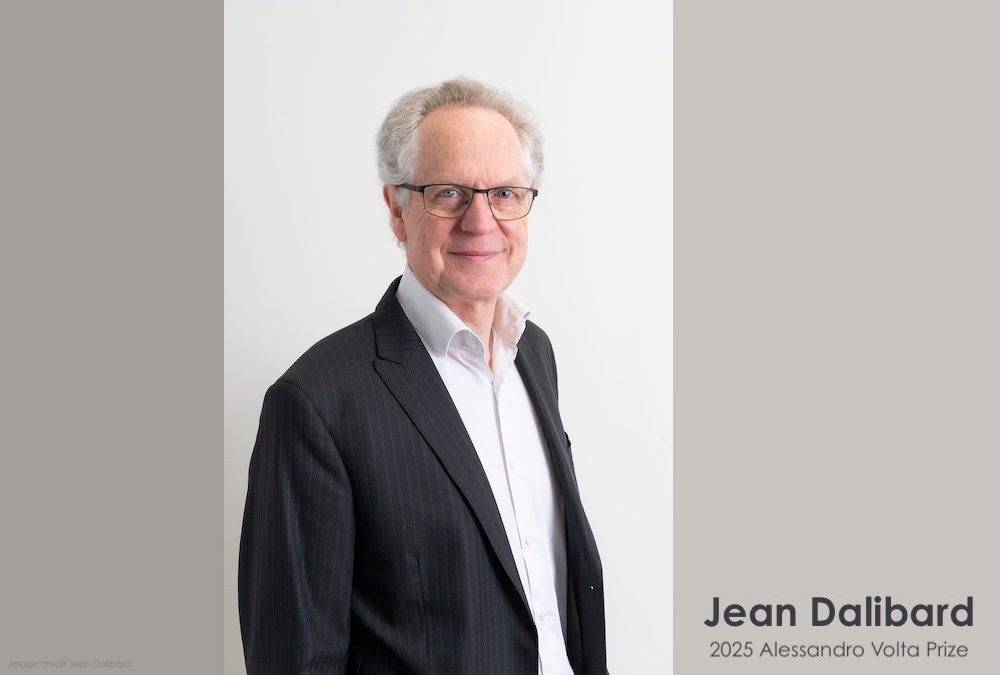
Jean Dalibard is a researcher and a professor of physics at the Collège de France. He was awarded the 2025 Alessandro Volta prize. A cermony dedicated to the first edition of this prize and to his research will be organised on 2nd October in Como, Italy.
Could you describe your current field of research?
My research is focused on quantum matter. I study ensembles of particles at ultra low temperatures, a field of wide range of applications, including atomic clocks, quantum sensors, quantum simulators and quantum computers, to name just a few.
Cooling gases to extremely low temperatures allows for the reproduction and investigation of quantum phenomena that are not yet fully understood, such as superconductivity. It also makes it possible to perform quantum simulations of physical systems that are difficult or impossible to reproduce directly in the laboratory, such as the extreme conditions found in neutron stars for example.
What are the challenges of this field?
The main challenge is to create environments that allow us to simulate the phenomena we are interested in and to discover new effects. This involves lowering the temperature of our samples, tailoring the landscape in which the particles move, and controlling how they interact with one another.
These advances benefit both metrology by enabling significant gain in the precision of sensors, and to quantum many-body physics, by allowing us to explore new aspects of collective quantum behaviour.
In May 2026, you were awarded the Alessandro Volta Prize for “pioneering contributions to laser cooling and light–matter interactions, and for groundbreaking experimental and theoretical achievements in the quantum many-body physics of ultracold gases“.
Could you give us details about these contributions and achievements?
This prize recognises a life’s work. I had the chance to study cold atoms when a lot of discoveries and work were still to accomplish.
The first lasers were invented and built in the 1960s, and about a decade later, tunable lasers were developed, allowing their colour, and hence their wavelength, to be adjusted to a very precise value. It was soon realized that these lasers could exert significant forces on atoms and provide a powerful way of controlling their motion and trajectories.
By the end of the 1970s, I was a young student, and at that time it was possible to work in this field with relatively simple ideas. And I was fortunate to have a few of those ideas myself! Together with Claude Cohen-Tannoudji, who was awarded the Nobel Prize in Physics in 1997, I developed what is now known as “Sisyphus cooling,” a laser-based technique for cooling atoms down to extremely low temperatures.[1]
Later I also proposed the idea of the magneto-optic trap (MOT) that is very much in use today. The MOT is “an apparatus which uses laser cooling and a spatially varying magnetic field to create a trap which can produce samples of cold neutral atoms. Temperatures achieved in a MOT can be as low as several microkelvins, depending on the atomic species.” [2], [3]
I was lucky to do both theoretical and experimental physics, whereas nowadays the trend is to specialise more in one of them. I still try to maintain both.
You were awarded numerous prizes and distinctions. What does the Alessandro Volta prize bring to you?
This prize launched by the European Physical Society (EPS) and Gruppo Acinque is very prestigious. I am very honoured to be awarded this distinction.
The EPS is a learned society that is world-famous. I think the role of such a society is very important. It does not have financial interests or the need to please anyone who would tell them what to do and what to think. At a time when “alternative truth” is spread all over the world, its role is to establish the “true truth”, i.e., factual truth.
Why did you study physics? Are there scientists who inspired you for your studies?
I often quote two reasons that encouraged me to study physics.
Firstly, I was a young boy in 1969 when humans walked on the Moon. For youngsters it was amazing. Even though I didn’t really want to walk on the Moon myself I thought it would be fantastic to be part of it, in the NASA room where you could control and follow this event.
The second reason is more personal. One of my grandfathers was a miller and he possessed a water mill. I was five or six years old and fascinated to see the mill running. The big rotating wheels were driving a system of pulleys, making the sacks of wheat be carried from one place to another and all sorts of mechanisms were put into movement that I wished to understand.
The combining of the two made me feel like working in science and technology. I chose my particular field mainly because of decisive encounters. An example of motivating teachers was Claude Cohen-Tanoudji. The way he was doing research was so interesting and he presented it an such an elegant way that I was very motivated to work with him. He accepted to be the supervisor of my PhD thesis.
Two other scientists inspired me a lot: Alain Aspect, with whom I worked during my master’s thesis on the Bell inequalities, and for which he received the Nobel prize in 2022.
Finally, William Phillips, one of the first experimentalists on cold atoms, was also an inspiration to me. I had the chance to undertake an internship in his laboratory.
With such talented physicists, I was well gifted for my career. Both Alain Aspect and William Phillips will attend the Alessandro Volta prize ceremony in Como and give a lecture.
What would you say to youngsters to encourage them to study physics?
I would like to start with a remark on the importance of studying science in general. We sometimes see young people turning away from science, holding it responsible for the problems facing the world. I believe, on the contrary, that acquiring a solid scientific background is essential if we are to take an informed part in the choices our society has to make, whether on energy, environmental issues, or public health.
And why physics among all the sciences? This is, of course, partly a matter of personal preference. For me, doing physics provides an opportunity to interact with many other disciplines while developing relatively simple models and relatively simple mathematics to address a wide range of phenomena in nature. I like to quote Galileo:
” [The universe] cannot be read until we have learnt the language and become familiar with the characters in which it is written. It is written in mathematical language, and the letters are triangles, circles and other geometrical figures, without which means it is humanly impossible to comprehend a single word.” – Galileo , in Opere Il Saggiatore p. 171.
In physics, you have the opportunity to use the language of mathematics to engage with Nature and try to understand how it works.
And sometimes, you develop a model that makes a clear prediction, only to find, when you test it experimentally, that Nature does exactly the opposite of what you expected! This is not a problem—it is part of what makes science so exciting. You can be wrong, learn from it, and eventually discover something you were not looking for. And even when you do not find the answer yourself, someone else may find it. This is one of the things I particularly like about science: we are part of a large community, working together to understand Nature.
More info and references